Risk management is the foundation of consistent success in active trading. The markets provide tremendous opportunities, but also huge risks that can destroy capital in an instant if risk management is not disciplined.
Retail traders should have a stringent set of risk management rules to safeguard their trading accounts, protect capital, and avoid the emotional traps that lead to poor decision-making.
The following rules, based on experience, technical knowledge, and good industry practices, are a must for any serious retail trader.
Below are ten essential risk management techniques that every retail trader should apply to protect their capital and improve long-term success.
Have a defined plan before entering any trade, which should include the entry price, exit price, stop-loss, and take-profit levels. Planning removes emotion and enables you to act strategically rather than reactively.
It is commonly advised to never risk more than 1%-2% of your overall trading account on any one trade. This way, even a streak of losses will not blow your account, and you can remain in the market long enough to capitalize on your edge.
Position size according to the dollar amount you are willing to lose. Position sizing ensures that the size of your trades aligns with your stop-loss and risk tolerance level.
Formula: Position Size = Amount Willing to Lose / Stop Loss per Share
Position Size = 6000 ÷ 30 = 200 shares
So you should buy 200 shares, because if your stop-loss hits at ₹1,470, your total loss = ₹6,000, which matches your risk tolerance.
Golden Rule: Never decide position based on “how much I want to buy”, always decide on “how much I can afford to lose”.
Stop loss orders close a trade when the price reaches a certain level. It also shields your capital from higher than anticipated losses and avoids emotional decision making in a volatile market.
Only enter trades that have a minimum 1:2 risk-to-reward ratio. This means if you are risking Rs. 10000, you want to try to make Rs. 20000 or more. This ratio, over time, improves your odds of staying profitable, even if you have a 50% win rate.
Train your mind. Trade with tools that reduce emotion.
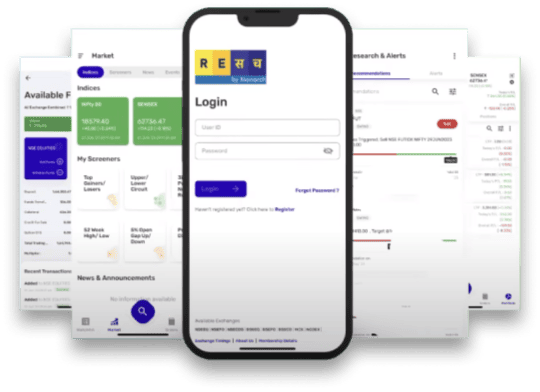
Manage risk like a pro. ReSach makes it simple with built-in tools.
Open Your Trading Account
Do not put all your money in one trade, asset class or sector. It mitigates portfolio volatility and minimizes concentration risk. Diversify your trades across different industries or instruments to control for risk.
Though retail traders cannot use the sophisticated models that institutions do, they can think like them. Think about how each trade contributes to the bigger picture and understand how much of your money is at risk in various types of trades.
Even without advanced software, retail traders can perform basic stress tests by imagining how their portfolios would perform under adverse scenarios such as sharp market corrections, rising inflation, or geopolitical shocks. This helps uncover hidden risks and build resilience in your trading plan.
Be mindful of current market volatility and adjust your stop-loss and position size accordingly. When the markets become shaky, using larger stop-losses and smaller position sizes can help avoid being stopped out frequently and keep your funds safe.
Regularly review your trade activities and risk management policies. One thing that trading and risk capital have in common is the ability to identify the good from the bad. Use this cycle as an aid to refine your strategy, work more effectively, and become more disciplined.
Don’t just learn risk management – live it.
Start trading with Resach by Monarch.
When retail traders are managing risks, they position themselves to weather market volatility and that helps in building long-term success. Retail traders may lack the deep pockets and technology of institutions, but by adopting the same principles and mindset, they can level the playing field.
Disclaimer: This blog is for educational purposes only and does not constitute investment advice, an offer tobuy/sell securities, or a recommendation. Past performance is not indicative of future results. Investors should consult a SEBI-registered advisor before making decisions. Mention of third-party entities is for illustration only and not an endorsement.
Readers are advised to consult their financial advisors or conduct independent research before making any investment decisions. Past performance is not indicative of future results. MNCL is a SEBI-registered intermediary (SEBI Registration No: INZ000008037). For further details, visit www.sebi.gov.in.



Empower your finances with ReSach – the stock trading apptrusted by serious investors. Whether you're planning to invest in stocks, explore commodity trading, or need a financial advisor to guide you, Resach brings it all under one platform.
Start trading today with ReSach and unlock seamless investing on the go.
Name of the Company has changed from Networth Stock Broking Limited to Monarch Networth Capital Limited upon Certification of Incorporation received from Registrar of Companies, Mumbai vide certificate dated 13th October, 2015.
If you are not satisfied with the resolution provided, you can lodge your complaint online at: https://scores.sebi.gov.in/link
In case of grievance client can log on to the SMART ODR Portal, if they are unsatisfied with the response provided by us. Your attention is drawn to the SEBI circular no. SEBI/HO/OIAE/OIAE_IAD-1/P/CIR/2023/131 dated July 31, 2023, on “Online Resolution of Disputes in the Indian Securities Market”.
Purchase of REs only gives buyer the right to participate in the ongoing Rights Issue of the concerned company by making an application with requisite application money or renounce the REs before the issue closes. REs which are neither subscribed by making an application with requisite application money nor renounced, on or before the Issue closing date shall lapse and shall be extinguished after the Issue closing date. Please check your dp account for further details.
Please do not share your online trading password with anyone as this could weaken the security of your account and lead to unauthorized trades or losses.
Monarch Networth Capital Limited (‘MNCL’) | CIN No.: L64990GJ1993PLC120014
Unit No. 803-804A, 8th Floor, X-Change Plaza, Block No. 53, Zone 5, Road-5E, Gift City, Gandhinagar - 382050, Gujarat
Ahmedabad
“Monarch House”, Opp Prahladbhai Patel garden, Near Ishwar Bhuvan, Commerce Six Roads, Navrangpura, Ahmedabad - 380009
Mumbai
Monarch Networth Capital Limited, G Block, Laxmi Tower, B Wing, 4th Floor, Bandra Kurla Complex, Bandra East, Mumbai - 400051.
Email for Grievance: grievances@mnclgroup.com
Investors are requested to note that Stock broker (Monarch Networth Capital Ltd) is permitted to receive money from investors through designated bank accounts only named as Up streaming Client Nodal Bank Account (USCNBA). Stock broker (Monarch Networth Capital Ltd) is also required to disclose these USCNB accounts to Stock Exchange. Hence, you are requested to use following USCNB accounts only (Click to View) for the purpose of dealings in your trading account with us. The details of these USCNB accounts are also displayed by Stock Exchanges on their website under “Know/ Locate your Stock Broker".
Mechanism for addressing grievances and information about SCORES.
Monarch Networth Capital IFSC Private Limited (Wholly owned subsidiary of Monarch Networth Capital Limited) is a Registered Fund Management Entity (Retail) having Registration No: IFSCA/FME/III/2025-26/169. Monarch India Growth Fund will be an open-ended Restricted Scheme (Non-Retail) construed as a Category III AIF under the IFSCA (Fund Management) Regulations, 2025. Monarch AIF is a Category III AIF having SEBI Registration No. IN/AIF3/20-21/0787. This material is for informational purposes only and is not intended as an offer or solicitation or investment advice to buy or sell securities. Investments are subject to market risks. The offering is made only through official scheme documents to eligible investors under GIFT IFSC regulations. Investors should read all documents carefully and consult their advisors before investing.
Mechanism for addressing grievances and information about SCORES.
Monarch Networth Capital Limited (‘MNCL’) | CIN No.: L64990GJ1993PLC120014
(As per LODR Regulations and Companies Act, 2013)
Contact information of the designated officials of the listed entity who are responsible for assisting and handling investor grievances : Mr. Nitesh Tanwar
Monarch Networth Capital Limited
Unit No. 803-804A, 8th Floor, X-Change Plaza, Block No. 53, Zone 5, Road-5E, Gift City, Gandhinagar - 382050, Gujarat
Ahmedabad
“Monarch House”, Opp Prahladbhai Patel garden, Near Ishwar Bhuvan, Commerce Six Roads, Navrangpura, Ahmedabad – 380009
Mumbai
Monarch Networth Capital Limited, G Block, Laxmi Tower, B Wing, 4th Floor, Bandra Kurla Complex, Bandra East, Mumbai - 400051.
Phone: 022 - 66476400 / 66476405
Email: cs@mnclgroup.com
Email for Grievance: cs@mnclgroup.com
Listing of Equity Shares on Stock Exchange at
BSE
NSE
(Formerly known as Link Intime India Private Limited)
For any queries related to broking please contact helpdesk@mnclgroup.com.
‘Investments in securities market are subject to market risks, read all the related documents carefully before investing.’