
In financial markets, equity research plays an important role in shaping how capital moves across the economy. Every company trying to raise funds, whether through equity, debt, or internally, depends on the collective judgment of investors. And that judgment is guided by equity research and stock market analysis.
At its core, investment research in India isn’t just about issuing “buy” or “sell” calls. It requires mastering how to analyse stocks, digging deep to understand how a business really works, analysing the quality of its management and seeing how today’s decisions can shape shareholder value in the future. In this blog, let’s understand the meaning of equity research and the role of equity research in capital allocation.
Equity research involves deeply analysing a company’s business, industry, management, financials and valuation to understand what it is truly worth compared to its current market price. It's like a reality check against market hype and noise, making sure excitement doesn’t replace evidence.
This is why equity research is important in markets. Without it, investing becomes guesswork. With equity research, capital allocation becomes a structured decision. While doing equity research, analysts look at companies:
Equity research matters because it bridges the gap between market perception and business reality. Instead of reacting to noise and headlines, it helps investors see what’s really happening inside a business. Through proper investment research, investors get a clearer view of company fundamentals, accounting quality, management behaviour and the true intrinsic value of a stock.
It helps you separate speculation from conviction and spot undervalued stocks in India that have strong fundamentals but are temporarily ignored by the market.
When it comes to capital allocation, equity research works as a filter. Analysts always study financial statements, industry trends and macro shifts to estimate fair value. This kind of stock market research investors rely on ensures money flows toward real value, not hype driven stories.
Corporate finance research begins with an evaluation of governance and reporting quality. This is where concepts like corporate governance analysis in India & accounting quality assessment come into play. Companies with transparent disclosures, independent boards & ethical accounting attract long-term capital faster.
Conversely, weak governance structures lead to capital misallocation, money flows into firms that may not sustain growth, causing eventual losses for both companies and shareholders. Equity research helps prevent this by flagging concerns early.
Analysts use qualitative evaluations to judge management behavior and accounting practices while ensuring that financial statements truly reflect business performance.
When governance is strong, investor confidence rises. But when governance is weak, smart money stays away, no matter what the price is. This is why serious investors turn to investor confidence research to judge whether a company truly deserves their capital before they write big cheques.
For investors looking for high conviction investment ideas, research is what separates short-term noise from long-term opportunity. When analysts blend accounting quality checks, governance assessment and macro understanding, they’re able to spot long-term investment strategies that genuinely support value creation.
One of the outcomes of equity research is the ability to identify undervalued stocks in India. These are companies with:
Here, equity valuation services play an important role. Analysts estimate intrinsic value by studying earnings, assets and cash flow potential. When price trades below the real value, patient investors find a high-conviction stock investment idea that aligns with their long-term goals.
At the portfolio level, equity research directly supports capital allocation decisions such as
This is important for investors planning wealth for retirement, children’s education or business expansion. Capital allocation is done by multiple investors, often leveraging professional portfolio management services to balance risk across retail portfolios, mutual funds, and promoter holdings. Every one of them relies on stock market analysis and investment research India to avoid blind bets. Detailed equity research helps answer questions like:
Without this framework, capital allocation turns emotional. And the market doesn’t reward emotion.
Equity research is not about predicting stock prices. It’s about protecting capital and directing it toward businesses where the chances of long-term success are higher. Equity research filters market noise and checks whether the numbers truly back it up. And the importance of equity research lies in helping money flow to the right businesses, at the right time, for the right reasons. And that’s what drives wealth creation in the markets, making equity research a key part of capital allocation.
Explore our latest research reports to make data-backed allocation decisions for your portfolio.
Disclaimer
The strategies discussed are for educational purposes only. Past performance is not indicative of future results. Trading involves risk of loss. Trading in securities, derivatives, or other financial instruments carries significant risk. Consult a financial advisor before making any decisions. This content is not an offer, recommendation, or solicitation for any product/service. For tailored advice, consult a SEBI-registered Investment adviser.



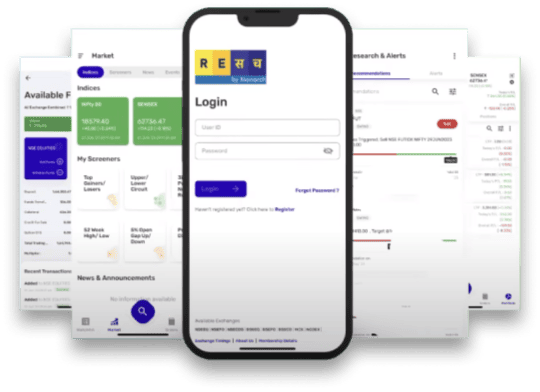
Empower your finances with ReSach – the stock trading apptrusted by serious investors. Whether you're planning to invest in stocks, explore commodity trading, or need a financial advisor to guide you, Resach brings it all under one platform.
Start trading today with ReSach and unlock seamless investing on the go.
Name of the Company has changed from Networth Stock Broking Limited to Monarch Networth Capital Limited upon Certification of Incorporation received from Registrar of Companies, Mumbai vide certificate dated 13th October, 2015.
If you are not satisfied with the resolution provided, you can lodge your complaint online at: https://scores.sebi.gov.in/link
In case of grievance client can log on to the SMART ODR Portal, if they are unsatisfied with the response provided by us. Your attention is drawn to the SEBI circular no. SEBI/HO/OIAE/OIAE_IAD-1/P/CIR/2023/131 dated July 31, 2023, on “Online Resolution of Disputes in the Indian Securities Market”.
Purchase of REs only gives buyer the right to participate in the ongoing Rights Issue of the concerned company by making an application with requisite application money or renounce the REs before the issue closes. REs which are neither subscribed by making an application with requisite application money nor renounced, on or before the Issue closing date shall lapse and shall be extinguished after the Issue closing date. Please check your dp account for further details.
Please do not share your online trading password with anyone as this could weaken the security of your account and lead to unauthorized trades or losses.
Monarch Networth Capital Limited (‘MNCL’) | CIN No.: L64990GJ1993PLC120014
Unit No. 803-804A, 8th Floor, X-Change Plaza, Block No. 53, Zone 5, Road-5E, Gift City, Gandhinagar - 382050, Gujarat
Ahmedabad
“Monarch House”, Opp Prahladbhai Patel garden, Near Ishwar Bhuvan, Commerce Six Roads, Navrangpura, Ahmedabad - 380009
Mumbai
Monarch Networth Capital Limited, G Block, Laxmi Tower, B Wing, 4th Floor, Bandra Kurla Complex, Bandra East, Mumbai - 400051.
Email for Grievance: grievances@mnclgroup.com
Investors are requested to note that Stock broker (Monarch Networth Capital Ltd) is permitted to receive money from investors through designated bank accounts only named as Up streaming Client Nodal Bank Account (USCNBA). Stock broker (Monarch Networth Capital Ltd) is also required to disclose these USCNB accounts to Stock Exchange. Hence, you are requested to use following USCNB accounts only (Click to View) for the purpose of dealings in your trading account with us. The details of these USCNB accounts are also displayed by Stock Exchanges on their website under “Know/ Locate your Stock Broker".
Mechanism for addressing grievances and information about SCORES.
Monarch Networth Capital IFSC Private Limited (Wholly owned subsidiary of Monarch Networth Capital Limited) is a Registered Fund Management Entity (Retail) having Registration No: IFSCA/FME/III/2025-26/169. Monarch India Growth Fund will be an open-ended Restricted Scheme (Non-Retail) construed as a Category III AIF under the IFSCA (Fund Management) Regulations, 2025. Monarch AIF is a Category III AIF having SEBI Registration No. IN/AIF3/20-21/0787. This material is for informational purposes only and is not intended as an offer or solicitation or investment advice to buy or sell securities. Investments are subject to market risks. The offering is made only through official scheme documents to eligible investors under GIFT IFSC regulations. Investors should read all documents carefully and consult their advisors before investing.
Mechanism for addressing grievances and information about SCORES.
Monarch Networth Capital Limited (‘MNCL’) | CIN No.: L64990GJ1993PLC120014
(As per LODR Regulations and Companies Act, 2013)
Contact information of the designated officials of the listed entity who are responsible for assisting and handling investor grievances : Mr. Nitesh Tanwar
Monarch Networth Capital Limited
Unit No. 803-804A, 8th Floor, X-Change Plaza, Block No. 53, Zone 5, Road-5E, Gift City, Gandhinagar - 382050, Gujarat
Ahmedabad
“Monarch House”, Opp Prahladbhai Patel garden, Near Ishwar Bhuvan, Commerce Six Roads, Navrangpura, Ahmedabad – 380009
Mumbai
Monarch Networth Capital Limited, G Block, Laxmi Tower, B Wing, 4th Floor, Bandra Kurla Complex, Bandra East, Mumbai - 400051.
Phone: 022 - 66476400 / 66476405
Email: cs@mnclgroup.com
Email for Grievance: cs@mnclgroup.com
Listing of Equity Shares on Stock Exchange at
BSE
NSE
(Formerly known as Link Intime India Private Limited)
For any queries related to broking please contact helpdesk@mnclgroup.com.
‘Investments in securities market are subject to market risks, read all the related documents carefully before investing.’