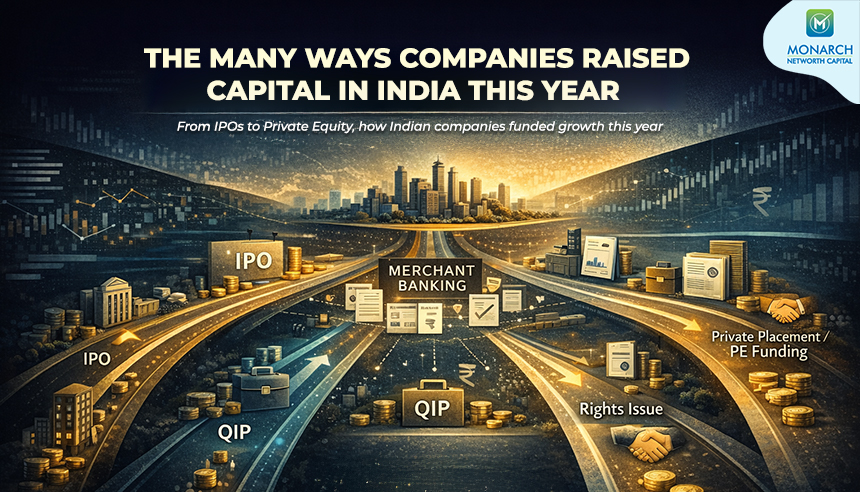
When you look at the Indian markets today, one thing you will notice, companies aren’t just building businesses. They’re constantly raising capital to grow, expand, deleverage, or unlock value. And unlike earlier times, there isn’t just one route anymore. From public offerings to PE funding, companies have a full capital-raising toolkit.
In this blog, let’s walk through the many ways to raise capital in India, how founders raise capital and why different capital raising methods suit different stages of growth.
Before getting into the routes, let’s address the main question, businesses raise capital to:
Here are some of the most popular ways through which founders raise capital in India today.
Every successful fundraising for businesses in India involves one crucial partner, the Merchant Banker. These financial experts act as backbone of financial services for companies while helping them structure, manage, and execute their fundraising process.
Merchant banks assist companies in:
Merchant banking ensures the capital raising journey runs smoothly, from due diligence to post-listing compliance.
Source: Investopedia
Example: ICICI Prudential AMC, which had earlier appointed a record 18 merchant bankers for its ₹10,000 Cr IPO, the highest for any Indian public issue in recent times.
The most visible and celebrated capital raising method is the public offering route. When companies go public, they invite retail and institutional investors to buy shares through an Initial Public Offering (IPO).
Advantages of IPOs include:
But IPOs also require strong disclosures, compliance, governance and performance history. Investors scrutinize these disclosures closely, often analysing stock fundamentals and market trends before committing capital. Which is why Merchant Banking teams play a key role in valuation, pricing, and investor communication.
And not every IPO issues fresh shares. Sometimes promoters or early investors sell part of their stake. That is called an OFS meaning Offer for Sale where the proceeds go to selling shareholders, not the company.
Example: Hyundai Motor India raised around ₹27,870 Cr, making it the largest IPO in Indian history. It has overtaken LIC’s earlier record IPO of ~₹21,000 Cr, setting a new milestone in the Indian primary market.
When evaluating private placement vs IPO, the key difference lies in audience and intent.
Private placements are less time intensive and maintain confidentiality while IPOs enhance public prestige & liquidity.
After the IPO, Qualified Institutional Placements (QIPs) continued to dominate the equity fundraising in India. In this method, a listed company issues new shares only to qualified institutional investors like mutual funds, banks, insurers, or FIIs. The company raises equity without going through the lengthy public issue process.
QIPs are popular because they are:
QIPs have become part of Indian companies' fundraising strategies for expansion or deleveraging.
Example: SBI raised ₹25,000 crore in July 2025 through India’s largest-ever QIP, surpassing Coal India’s previous record from 2015.
The company offers existing shareholders the right to buy additional shares usually at a discount. This protects current investors from dilution and lets them participate in the company's growth.
Rights issues are a form of fundraising for businesses where companies give existing investors the first chance to buy new shares while helping them maintain their ownership while the company raises fresh capital.
Example: Reliance Industries, India’s largest listed company by market capitalisation, completed the country’s biggest-ever rights issue of ₹53,125 crore in 2020, marking the company’s first rights issue in nearly three decades.
Private equity funding is another way to raise capital in India. It happens when institutional investors buy a significant stake in a private or listed company to support growth.
Private equity firms also bring strategy, global expertise and operational discipline. For many businesses, especially mid-market firms, this is one of the smartest ways to raise capital in India.
Founders looking for how to raise capital without going public often find PE funding attractive, as it allows them to focus on long-term growth over quarterly earnings pressures.
Now you have a clear picture of the different ways to raise capital in India. Today, companies don’t depend on just one source of funding. They tap IPOs, QIPs, rights issues, private equity and other capital raising routes based on what suits their growth plans. This flexibility has helped businesses expand, deleverage, invest in technology, scale faster and stay competitive in a rapidly evolving market.
Disclaimer
The strategies discussed are for educational purposes only. Past performance is not indicative of future results. Trading involves risk of loss. Trading in securities, derivatives, or other financial instruments carries significant risk. Consult a financial advisor before making any decisions. This content is not an offer, recommendation, or solicitation for any product/service. For tailored advice, consult a SEBI-registered Investment adviser.



Empower your finances with ReSach – the stock trading apptrusted by serious investors. Whether you're planning to invest in stocks, explore commodity trading, or need a financial advisor to guide you, Resach brings it all under one platform.
Start trading today with ReSach and unlock seamless investing on the go.
Name of the Company has changed from Networth Stock Broking Limited to Monarch Networth Capital Limited upon Certification of Incorporation received from Registrar of Companies, Mumbai vide certificate dated 13th October, 2015.
If you are not satisfied with the resolution provided, you can lodge your complaint online at: https://scores.sebi.gov.in/link
In case of grievance client can log on to the SMART ODR Portal, if they are unsatisfied with the response provided by us. Your attention is drawn to the SEBI circular no. SEBI/HO/OIAE/OIAE_IAD-1/P/CIR/2023/131 dated July 31, 2023, on “Online Resolution of Disputes in the Indian Securities Market”.
Purchase of REs only gives buyer the right to participate in the ongoing Rights Issue of the concerned company by making an application with requisite application money or renounce the REs before the issue closes. REs which are neither subscribed by making an application with requisite application money nor renounced, on or before the Issue closing date shall lapse and shall be extinguished after the Issue closing date. Please check your dp account for further details.
Please do not share your online trading password with anyone as this could weaken the security of your account and lead to unauthorized trades or losses.
Monarch Networth Capital Limited (‘MNCL’) | CIN No.: L64990GJ1993PLC120014
Unit No. 803-804A, 8th Floor, X-Change Plaza, Block No. 53, Zone 5, Road-5E, Gift City, Gandhinagar - 382050, Gujarat
Ahmedabad
“Monarch House”, Opp Prahladbhai Patel garden, Near Ishwar Bhuvan, Commerce Six Roads, Navrangpura, Ahmedabad - 380009
Mumbai
Monarch Networth Capital Limited, G Block, Laxmi Tower, B Wing, 4th Floor, Bandra Kurla Complex, Bandra East, Mumbai - 400051.
Email for Grievance: grievances@mnclgroup.com
Investors are requested to note that Stock broker (Monarch Networth Capital Ltd) is permitted to receive money from investors through designated bank accounts only named as Up streaming Client Nodal Bank Account (USCNBA). Stock broker (Monarch Networth Capital Ltd) is also required to disclose these USCNB accounts to Stock Exchange. Hence, you are requested to use following USCNB accounts only (Click to View) for the purpose of dealings in your trading account with us. The details of these USCNB accounts are also displayed by Stock Exchanges on their website under “Know/ Locate your Stock Broker".
Mechanism for addressing grievances and information about SCORES.
Monarch Networth Capital IFSC Private Limited (Wholly owned subsidiary of Monarch Networth Capital Limited) is a Registered Fund Management Entity (Retail) having Registration No: IFSCA/FME/III/2025-26/169. Monarch India Growth Fund will be an open-ended Restricted Scheme (Non-Retail) construed as a Category III AIF under the IFSCA (Fund Management) Regulations, 2025. Monarch AIF is a Category III AIF having SEBI Registration No. IN/AIF3/20-21/0787. This material is for informational purposes only and is not intended as an offer or solicitation or investment advice to buy or sell securities. Investments are subject to market risks. The offering is made only through official scheme documents to eligible investors under GIFT IFSC regulations. Investors should read all documents carefully and consult their advisors before investing.
Mechanism for addressing grievances and information about SCORES.
Monarch Networth Capital Limited (‘MNCL’) | CIN No.: L64990GJ1993PLC120014
(As per LODR Regulations and Companies Act, 2013)
Contact information of the designated officials of the listed entity who are responsible for assisting and handling investor grievances : Mr. Nitesh Tanwar
Monarch Networth Capital Limited
Unit No. 803-804A, 8th Floor, X-Change Plaza, Block No. 53, Zone 5, Road-5E, Gift City, Gandhinagar - 382050, Gujarat
Ahmedabad
“Monarch House”, Opp Prahladbhai Patel garden, Near Ishwar Bhuvan, Commerce Six Roads, Navrangpura, Ahmedabad – 380009
Mumbai
Monarch Networth Capital Limited, G Block, Laxmi Tower, B Wing, 4th Floor, Bandra Kurla Complex, Bandra East, Mumbai - 400051.
Phone: 022 - 66476400 / 66476405
Email: cs@mnclgroup.com
Email for Grievance: cs@mnclgroup.com
Listing of Equity Shares on Stock Exchange at
BSE
NSE
(Formerly known as Link Intime India Private Limited)
For any queries related to broking please contact helpdesk@mnclgroup.com.
‘Investments in securities market are subject to market risks, read all the related documents carefully before investing.’