
Value investing is one of the most reliable ways to build long-term wealth in the stock market. Benjamin Graham popularised this philosophy and was later refined by Warren Buffett. In India, investors like Rakesh Jhunjhunwala followed similar long-term, conviction-based principles.
Value investing focuses on buying high-quality companies when they are trading below their true worth. Instead of chasing trendy stocks or trying to predict short-term market moves, value investors think like business owners.
Whether you are starting with a small portfolio or just learning the basics, value investing rewards patience, research and discipline. For those taking their first steps, picking the right stock broker is a foundational move before deploying your capital. In this blog, we’ll walk you through what is value investing and how to select good stocks, step by step.
Value investing is not about buying cheap stocks. It is about buying businesses that are worth more than the market currently prices them.
Cheap and undervalued are not the same. A stock can trade at ₹50 and still be expensive. If the company is making losses, carrying heavy debt or its business is shrinking, that low price is not an opportunity. It is a warning sign.
Value investing looks beyond the price tag. It focuses on fundamentals such as:
Markets often misprice good businesses because of bad news, economic slowdowns or temporary sector neglect. Value investors wait for these phases to buy strong companies below their true worth and remain patient until the market corrects the price.
Unlike growth investing which pays a premium for future expansion, value investing prefers established, profitable businesses available at sensible valuations.
Start by using a stock screener to narrow down thousands of listed companies and filter them using basic criteria.
Once you have 20 to 50 good companies, you can dig deeper by analysing fundamental indicators, charts, and market trends to assess their true underlying strength:
So, you should avoid companies with declining sales or heavy debt.
Before investing, why will this company survive and grow for the next 10 to 15 years? A strong business usually has some kind of advantage that competitors cannot easily copy. This is called a competitive moat.
It can come from:
If competitors can easily enter and destroy margins, the business is not durable.
Go through annual reports to understand how management thinks, not just how much the company earns. A good business with poor management can destroy wealth.
Diversify across 10 to 15 quality (depends on capital) stocks to manage risk without overcomplicating tracking, though some investors prefer exploring professional portfolio management services for dedicated oversight.. Ignore short-term price swings and sell only if fundamentals weaken. Review revenue, debt, margins and management updates regularly. If the core story is intact, stay invested.
Disclaimer: Investments in the securities market are subject to market risks, read all the related documents carefully before investing. The information provided in this material is only for education purposes and should not be used for public distribution and must not be reproduced or redistributed to any other person. One must consult their legal, tax and financial advisors before taking any investment related decisions. https://www.mnclgroup.com/research-disclaimer



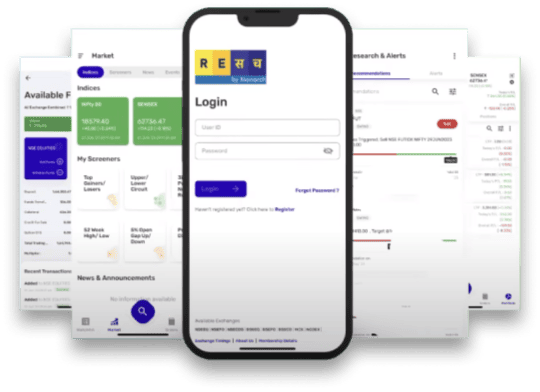
Empower your finances with ReSach – the stock trading apptrusted by serious investors. Whether you're planning to invest in stocks, explore commodity trading, or need a financial advisor to guide you, Resach brings it all under one platform.
Start trading today with ReSach and unlock seamless investing on the go.
Name of the Company has changed from Networth Stock Broking Limited to Monarch Networth Capital Limited upon Certification of Incorporation received from Registrar of Companies, Mumbai vide certificate dated 13th October, 2015.
If you are not satisfied with the resolution provided, you can lodge your complaint online at: https://scores.sebi.gov.in/link
In case of grievance client can log on to the SMART ODR Portal, if they are unsatisfied with the response provided by us. Your attention is drawn to the SEBI circular no. SEBI/HO/OIAE/OIAE_IAD-1/P/CIR/2023/131 dated July 31, 2023, on “Online Resolution of Disputes in the Indian Securities Market”.
Purchase of REs only gives buyer the right to participate in the ongoing Rights Issue of the concerned company by making an application with requisite application money or renounce the REs before the issue closes. REs which are neither subscribed by making an application with requisite application money nor renounced, on or before the Issue closing date shall lapse and shall be extinguished after the Issue closing date. Please check your dp account for further details.
Please do not share your online trading password with anyone as this could weaken the security of your account and lead to unauthorized trades or losses.
Monarch Networth Capital Limited (‘MNCL’) | CIN No.: L64990GJ1993PLC120014
Unit No. 803-804A, 8th Floor, X-Change Plaza, Block No. 53, Zone 5, Road-5E, Gift City, Gandhinagar - 382050, Gujarat
Ahmedabad
“Monarch House”, Opp Prahladbhai Patel garden, Near Ishwar Bhuvan, Commerce Six Roads, Navrangpura, Ahmedabad - 380009
Mumbai
Monarch Networth Capital Limited, G Block, Laxmi Tower, B Wing, 4th Floor, Bandra Kurla Complex, Bandra East, Mumbai - 400051.
Email for Grievance: grievances@mnclgroup.com
Investors are requested to note that Stock broker (Monarch Networth Capital Ltd) is permitted to receive money from investors through designated bank accounts only named as Up streaming Client Nodal Bank Account (USCNBA). Stock broker (Monarch Networth Capital Ltd) is also required to disclose these USCNB accounts to Stock Exchange. Hence, you are requested to use following USCNB accounts only (Click to View) for the purpose of dealings in your trading account with us. The details of these USCNB accounts are also displayed by Stock Exchanges on their website under “Know/ Locate your Stock Broker".
Mechanism for addressing grievances and information about SCORES.
Monarch Networth Capital IFSC Private Limited (Wholly owned subsidiary of Monarch Networth Capital Limited) is a Registered Fund Management Entity (Retail) having Registration No: IFSCA/FME/III/2025-26/169. Monarch India Growth Fund will be an open-ended Restricted Scheme (Non-Retail) construed as a Category III AIF under the IFSCA (Fund Management) Regulations, 2025. Monarch AIF is a Category III AIF having SEBI Registration No. IN/AIF3/20-21/0787. This material is for informational purposes only and is not intended as an offer or solicitation or investment advice to buy or sell securities. Investments are subject to market risks. The offering is made only through official scheme documents to eligible investors under GIFT IFSC regulations. Investors should read all documents carefully and consult their advisors before investing.
Mechanism for addressing grievances and information about SCORES.
Monarch Networth Capital Limited (‘MNCL’) | CIN No.: L64990GJ1993PLC120014
(As per LODR Regulations and Companies Act, 2013)
Contact information of the designated officials of the listed entity who are responsible for assisting and handling investor grievances : Mr. Nitesh Tanwar
Monarch Networth Capital Limited
Unit No. 803-804A, 8th Floor, X-Change Plaza, Block No. 53, Zone 5, Road-5E, Gift City, Gandhinagar - 382050, Gujarat
Ahmedabad
“Monarch House”, Opp Prahladbhai Patel garden, Near Ishwar Bhuvan, Commerce Six Roads, Navrangpura, Ahmedabad – 380009
Mumbai
Monarch Networth Capital Limited, G Block, Laxmi Tower, B Wing, 4th Floor, Bandra Kurla Complex, Bandra East, Mumbai - 400051.
Phone: 022 - 66476400 / 66476405
Email: cs@mnclgroup.com
Email for Grievance: cs@mnclgroup.com
Listing of Equity Shares on Stock Exchange at
BSE
NSE
(Formerly known as Link Intime India Private Limited)
For any queries related to broking please contact helpdesk@mnclgroup.com.
‘Investments in securities market are subject to market risks, read all the related documents carefully before investing.’