Getting started with the stock market is a financially prudent move. It gives you a chance to grow your money over time by investing in companies and benefiting from the economy’s progress. But here’s the catch—you cannot directly buy or sell shares on stock exchanges like the National Stock Exchange (NSE) or the Bombay Stock Exchange (BSE).
For that, you need a stock broker—an intermediary registered with the Securities and Exchange Board of India (SEBI) who places orders on your behalf and gives you access to the stock market.
With so many broking firms and stock trading platforms out there, it’s essential you take some time and pick a stock broker that's right for you. Some brokers may offer low-cost trades but limited features. Other brokers might give you quality research tools but charge significantly higher fees.
Hence, choosing the right broker is more than just clicking “Sign Up.” It’s about finding a trusted partner who fits your investing style, trading goals, and budget. When you choose a well-suited trading platform, you increase your chances of maximising returns and having a smoother stock market journey.
In this guide, you will learn how to choose the right stock market broker, what to consider before stepping into the market, and whether an online or offline approach is better for you.
There are a few important factors to consider when choosing the right stock market broker. Considering these factors can make the process less overwhelming.
First things first, you need to check if the broker is registered with SEBI since only SEBI-registered brokers can legally execute trades for retail investors.
A legitimate way to check this is to go to SEBI’s official website and access the full SEBI-registered brokers list. This list is regularly updated by SEBI and ensures that you can cross-verify the broker’s SEBI registration number before signing up.
Primarily, there are two types of stock market brokers:
If you're just starting out and want expert input, a full-service broker might be better suited. But if you're cost-conscious and confident about learning on the go, a discount broking firm could work better for you.
You need to decide how you want to interact with your stock broker—through a mobile app or web portal online or through a personal advisor offline.
Here’s a quick comparison between online and offline retail broking to help you decide:
| Feature | Online Broking | Offline broking |
|---|---|---|
| How it works | You place orders via a mobile app or website | You call or visit a broker who places orders for you |
| Speed and convenience | Instant, 24x7 access | Depends on the broker’s availability |
| Cost | Lower brokerage (especially with discount brokers) | Higher brokerage (especially with full-service brokers) |
| Customer support | Chat, call centre, or ticket-based support | One-on-one support, often with a dedicated relationship manager |
| Features offered | Advanced tools like real-time charts, screeners, and portfolio trackers | Customised planning, personalised recommendations, tax planning, and more |
| Flexibility | Higher—more control over your portfolio and trades | Lower, since you are reliant on your broker for action |
| Account opening process | Instant, paperless, and 100% digital | Paperwork required, often assisted onboarding through branch |
| Suitable for | Independent investors, tech-savvy users | Investors who require offline support and guidance |
You can begin with online broking for daily trades and convenience and keep offline support handy for long-term planning and guidance.
Take some time to analyse the investment products offered by the stock broker. The best stock trading platform is the one which offers you the convenience to invest in multiple securities, such as:
Such a range will allow you to diversify your portfolio to minimise risks and maximise returns. Also, check if the stock market broker provides access to investments outside the Indian market, for example, US stocks. Adding international exposure to your portfolio can be a strategic move.
Whether you want to make short-term trades or build a diversified investment portfolio, it’s important to make informed decisions. For this, access to reliable and timely market data and research tools is critical.
Look for a stock trading platform that provides you access to:
Often, beginners underestimate the role the trading platform plays in making or breaking their stock market experience. To steer clear of that mistake, check if the trading platform provides:
Once you’ve picked the best trading platform or broker and opened a demat account, you might be tempted to immediately place a buy order. But before you dive into the share market, it’s essential to keep these things in mind:
Choosing the right stock broker is the first step in your stock market journey, and is a crucial one. But it’s not about picking the broker with the lowest fees or the fanciest online platforms. It’s about finding a trustworthy, SEBI-registered broker that aligns with your investing preferences and comfort level—whether that’s online, offline, or a mix of both.
Once you’ve done your due diligence and selected the best stock trading platform, take the time to learn, experiment, and grow gradually in the share market. When you approach the stock market with the right stock broker, patience, and goal-based strategies, it can be a powerful tool for building wealth and meeting other financial goals.



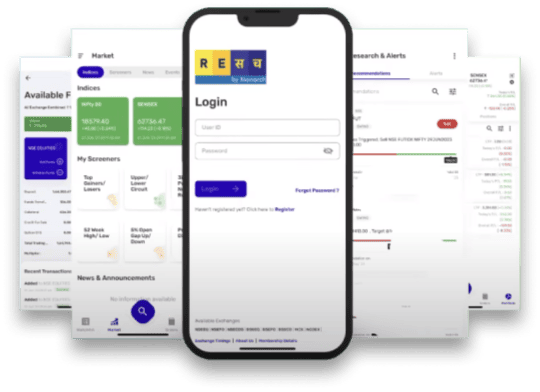
Empower your finances with ReSach – the stock trading apptrusted by serious investors. Whether you're planning to invest in stocks, explore commodity trading, or need a financial advisor to guide you, Resach brings it all under one platform.
Start trading today with ReSach and unlock seamless investing on the go.
Name of the Company has changed from Networth Stock Broking Limited to Monarch Networth Capital Limited upon Certification of Incorporation received from Registrar of Companies, Mumbai vide certificate dated 13th October, 2015.
If you are not satisfied with the resolution provided, you can lodge your complaint online at: https://scores.sebi.gov.in/link
In case of grievance client can log on to the SMART ODR Portal, if they are unsatisfied with the response provided by us. Your attention is drawn to the SEBI circular no. SEBI/HO/OIAE/OIAE_IAD-1/P/CIR/2023/131 dated July 31, 2023, on “Online Resolution of Disputes in the Indian Securities Market”.
Purchase of REs only gives buyer the right to participate in the ongoing Rights Issue of the concerned company by making an application with requisite application money or renounce the REs before the issue closes. REs which are neither subscribed by making an application with requisite application money nor renounced, on or before the Issue closing date shall lapse and shall be extinguished after the Issue closing date. Please check your dp account for further details.
Please do not share your online trading password with anyone as this could weaken the security of your account and lead to unauthorized trades or losses.
Monarch Networth Capital Limited (‘MNCL’) | CIN No.: L64990GJ1993PLC120014
Unit No. 803-804A, 8th Floor, X-Change Plaza, Block No. 53, Zone 5, Road-5E, Gift City, Gandhinagar - 382050, Gujarat
Ahmedabad
“Monarch House”, Opp Prahladbhai Patel garden, Near Ishwar Bhuvan, Commerce Six Roads, Navrangpura, Ahmedabad - 380009
Mumbai
Monarch Networth Capital Limited, G Block, Laxmi Tower, B Wing, 4th Floor, Bandra Kurla Complex, Bandra East, Mumbai - 400051.
Email for Grievance: grievances@mnclgroup.com
Investors are requested to note that Stock broker (Monarch Networth Capital Ltd) is permitted to receive money from investors through designated bank accounts only named as Up streaming Client Nodal Bank Account (USCNBA). Stock broker (Monarch Networth Capital Ltd) is also required to disclose these USCNB accounts to Stock Exchange. Hence, you are requested to use following USCNB accounts only (Click to View) for the purpose of dealings in your trading account with us. The details of these USCNB accounts are also displayed by Stock Exchanges on their website under “Know/ Locate your Stock Broker".
Mechanism for addressing grievances and information about SCORES.
Monarch Networth Capital IFSC Private Limited (Wholly owned subsidiary of Monarch Networth Capital Limited) is a Registered Fund Management Entity (Retail) having Registration No: IFSCA/FME/III/2025-26/169. Monarch India Growth Fund will be an open-ended Restricted Scheme (Non-Retail) construed as a Category III AIF under the IFSCA (Fund Management) Regulations, 2025. Monarch AIF is a Category III AIF having SEBI Registration No. IN/AIF3/20-21/0787. This material is for informational purposes only and is not intended as an offer or solicitation or investment advice to buy or sell securities. Investments are subject to market risks. The offering is made only through official scheme documents to eligible investors under GIFT IFSC regulations. Investors should read all documents carefully and consult their advisors before investing.
Mechanism for addressing grievances and information about SCORES.
Monarch Networth Capital Limited (‘MNCL’) | CIN No.: L64990GJ1993PLC120014
(As per LODR Regulations and Companies Act, 2013)
Contact information of the designated officials of the listed entity who are responsible for assisting and handling investor grievances : Mr. Nitesh Tanwar
Monarch Networth Capital Limited
Unit No. 803-804A, 8th Floor, X-Change Plaza, Block No. 53, Zone 5, Road-5E, Gift City, Gandhinagar - 382050, Gujarat
Ahmedabad
“Monarch House”, Opp Prahladbhai Patel garden, Near Ishwar Bhuvan, Commerce Six Roads, Navrangpura, Ahmedabad – 380009
Mumbai
Monarch Networth Capital Limited, G Block, Laxmi Tower, B Wing, 4th Floor, Bandra Kurla Complex, Bandra East, Mumbai - 400051.
Phone: 022 - 66476400 / 66476405
Email: cs@mnclgroup.com
Email for Grievance: cs@mnclgroup.com
Listing of Equity Shares on Stock Exchange at
BSE
NSE
(Formerly known as Link Intime India Private Limited)
For any queries related to broking please contact helpdesk@mnclgroup.com.
‘Investments in securities market are subject to market risks, read all the related documents carefully before investing.’