Economic indicators serve as an economy's real-time dashboard while showing its health and direction. Metrics like GDP, inflation, interest rates and unemployment drive market movements and influence investors.
By analysing these indicators, investors can anticipate trends, evaluate market fundamentals, and navigate volatility instead of reacting emotionally to short-term fluctuations. Let’s understand what economic indicators are and how they affect the stock market.
Economic indicators are data points that show how healthy or weak an economy is at a given time. Common examples include GDP growth, inflation rates, unemployment levels, interest rates and consumer spending. These indicators are released regularly by governments and central banks and traders worldwide track them closely. A strong number usually lifts market sentiment, while weak data can trigger sell-offs.
Following are some economic indicators every trader and investor should know, along with how they impact the market.
GDP measures the total value of goods and services produced in a country. Strong GDP growth means companies are likely earning more, consumer demand is rising and confidence is high. That generally supports higher stock prices and stronger markets. A slowdown or contraction can signal trouble, lower demand, weaker profits and possible policy intervention. (Angel One)
Inflation shows how fast prices are rising in the economy. Moderate inflation isn’t bad, but when prices surge too quickly, it eats into consumer spending and business profit margins. High inflation often prompts central banks to raise interest rates, making loans costlier for companies and consumers.
Higher interest rates increase borrowing costs for companies and consumers which can slow growth and reduce stock valuations. In such environments, investors often pivot to defensive trading strategies to preserve capital. Meanwhile, safer assets like bonds become more appealing, drawing funds away from equities.
Higher GST collections usually signal strong economic activity and healthy consumer spending. When these numbers are strong, markets often turn positive as it suggests businesses are selling more. GST collection data is released monthly by GST Council and is closely tracked by investors.
Employment data especially the unemployment rate, shows how many people are working and earning. Low unemployment generally supports markets because more people have income to spend, boosting company revenues.
Consumer spending indicators like retail sales are crucial because consumption is a major part of GDP. Weak jobs or spending numbers can signal slowdown fears and quickly turn market sentiment negative.
PMI measures business sentiment in manufacturing and services before official GDP numbers arrive. A reading above 50 signals expansion and can boost markets. Below 50 suggests contraction..
Because PMI is released monthly markets use it as an early indicator of economic momentum even before official GDP or employment data.
Retail sales reflect actual consumer spending, a huge part of GDP. Strong retail numbers show healthy demand which supports revenues and stock valuations, especially in consumer-facing sectors. Weak retail data suggests consumer caution which markets often dislike. (The Economic Times)
Other indicators like the Index of Industrial Production (IIP), Consumer Price Index (CPI) and repo rate are also important. Investors should track these along with the indicators mentioned above
Markets are forward-looking. Stocks usually move before official data is released, based on what traders expect. If GDP report is expected to beat estimates, markets may rise in advance. Similarly if surprise rate hike can trigger a sell-off because it was not priced in. This is why economists’ forecasts matter nearly as much as the actual data. Markets react to expectations, not just facts.
Stay ahead of market trends by tracking these indicators alongside our latest technical reports
Sources:
https://economictimes.indiatimes.com/markets/stocks/news/learn-with-etmarkets-role-of-economic-indicators-in-stock-market-analysis/articleshow/107595357.cms?from=mdr
https://www.ultimamarkets.com/academy/key-economic-indicators-every-trader-should-follow/?utm_source=chatgpt.com
https://www.bajajamc.com/knowledge-centre/economic-indicators-impact-on-stocks
Disclaimer: This blog is for educational purposes only and does not constitute investment advice, an offer to buy/sell securities, or a recommendation. Past performance is not indicative of future results. Investors should consult a SEBI-registered advisor before making decisions. Mention of third-party entities is for illustration only and not an endorsement. Readers are advised to consult their financial advisors or conduct independent research before making any investment decisions. Past performance is not indicative of future results. MNCL is a SEBI-registered intermediary (SEBI Registration No: INZ000008037). For further details, visit www.sebi.gov.in.



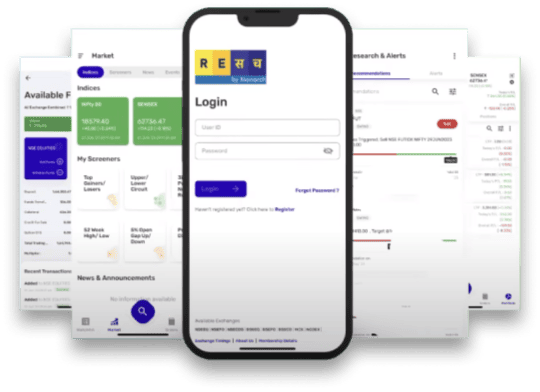
Empower your finances with ReSach – the stock trading apptrusted by serious investors. Whether you're planning to invest in stocks, explore commodity trading, or need a financial advisor to guide you, Resach brings it all under one platform.
Start trading today with ReSach and unlock seamless investing on the go.
Name of the Company has changed from Networth Stock Broking Limited to Monarch Networth Capital Limited upon Certification of Incorporation received from Registrar of Companies, Mumbai vide certificate dated 13th October, 2015.
If you are not satisfied with the resolution provided, you can lodge your complaint online at: https://scores.sebi.gov.in/link
In case of grievance client can log on to the SMART ODR Portal, if they are unsatisfied with the response provided by us. Your attention is drawn to the SEBI circular no. SEBI/HO/OIAE/OIAE_IAD-1/P/CIR/2023/131 dated July 31, 2023, on “Online Resolution of Disputes in the Indian Securities Market”.
Purchase of REs only gives buyer the right to participate in the ongoing Rights Issue of the concerned company by making an application with requisite application money or renounce the REs before the issue closes. REs which are neither subscribed by making an application with requisite application money nor renounced, on or before the Issue closing date shall lapse and shall be extinguished after the Issue closing date. Please check your dp account for further details.
Please do not share your online trading password with anyone as this could weaken the security of your account and lead to unauthorized trades or losses.
Monarch Networth Capital Limited (‘MNCL’) | CIN No.: L64990GJ1993PLC120014
Unit No. 803-804A, 8th Floor, X-Change Plaza, Block No. 53, Zone 5, Road-5E, Gift City, Gandhinagar - 382050, Gujarat
Ahmedabad
“Monarch House”, Opp Prahladbhai Patel garden, Near Ishwar Bhuvan, Commerce Six Roads, Navrangpura, Ahmedabad - 380009
Mumbai
Monarch Networth Capital Limited, G Block, Laxmi Tower, B Wing, 4th Floor, Bandra Kurla Complex, Bandra East, Mumbai - 400051.
Email for Grievance: grievances@mnclgroup.com
Investors are requested to note that Stock broker (Monarch Networth Capital Ltd) is permitted to receive money from investors through designated bank accounts only named as Up streaming Client Nodal Bank Account (USCNBA). Stock broker (Monarch Networth Capital Ltd) is also required to disclose these USCNB accounts to Stock Exchange. Hence, you are requested to use following USCNB accounts only (Click to View) for the purpose of dealings in your trading account with us. The details of these USCNB accounts are also displayed by Stock Exchanges on their website under “Know/ Locate your Stock Broker".
Mechanism for addressing grievances and information about SCORES.
Monarch Networth Capital IFSC Private Limited (Wholly owned subsidiary of Monarch Networth Capital Limited) is a Registered Fund Management Entity (Retail) having Registration No: IFSCA/FME/III/2025-26/169. Monarch India Growth Fund will be an open-ended Restricted Scheme (Non-Retail) construed as a Category III AIF under the IFSCA (Fund Management) Regulations, 2025. Monarch AIF is a Category III AIF having SEBI Registration No. IN/AIF3/20-21/0787. This material is for informational purposes only and is not intended as an offer or solicitation or investment advice to buy or sell securities. Investments are subject to market risks. The offering is made only through official scheme documents to eligible investors under GIFT IFSC regulations. Investors should read all documents carefully and consult their advisors before investing.
Mechanism for addressing grievances and information about SCORES.
Monarch Networth Capital Limited (‘MNCL’) | CIN No.: L64990GJ1993PLC120014
(As per LODR Regulations and Companies Act, 2013)
Contact information of the designated officials of the listed entity who are responsible for assisting and handling investor grievances : Mr. Nitesh Tanwar
Monarch Networth Capital Limited
Unit No. 803-804A, 8th Floor, X-Change Plaza, Block No. 53, Zone 5, Road-5E, Gift City, Gandhinagar - 382050, Gujarat
Ahmedabad
“Monarch House”, Opp Prahladbhai Patel garden, Near Ishwar Bhuvan, Commerce Six Roads, Navrangpura, Ahmedabad – 380009
Mumbai
Monarch Networth Capital Limited, G Block, Laxmi Tower, B Wing, 4th Floor, Bandra Kurla Complex, Bandra East, Mumbai - 400051.
Phone: 022 - 66476400 / 66476405
Email: cs@mnclgroup.com
Email for Grievance: cs@mnclgroup.com
Listing of Equity Shares on Stock Exchange at
BSE
NSE
(Formerly known as Link Intime India Private Limited)
For any queries related to broking please contact helpdesk@mnclgroup.com.
‘Investments in securities market are subject to market risks, read all the related documents carefully before investing.’