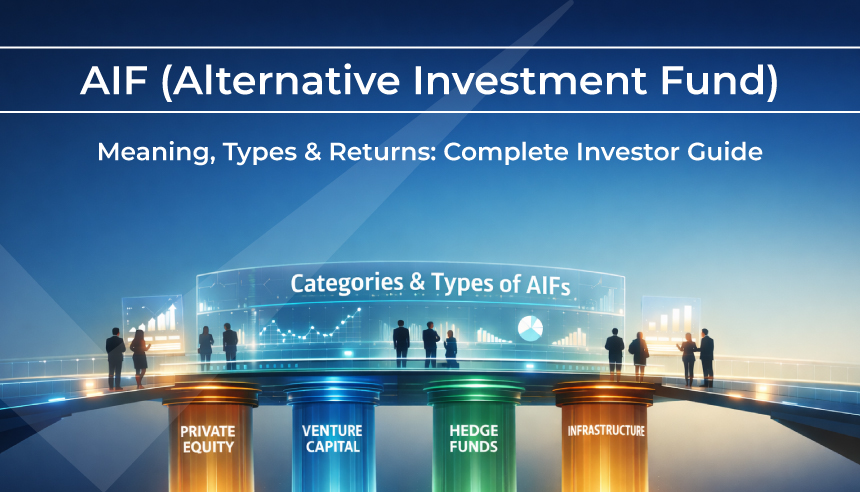
If you are a High Net Worth Individual looking beyond stocks, mutual funds, fixed deposits, or customized portfolio management services, Alternative Investment Funds (AIFs) may be worth exploring.Alternative Investment Funds (AIFs) may be worth exploring. In recent years, AIFs have gained attention among sophisticated investors seeking differentiated opportunities and potentially higher returns. However, these investments also come with higher risk, longer lock-ins and limited liquidity.
Unlike traditional retail products, AIFs are designed mainly for accredited and HNI investors and are managed by professional investment teams under the regulation of SEBI. In this blog, we will understand what are AIFs, types of AIFs and what kind of return potential and risks investors should evaluate before investing.
Alternative Investment Funds (AIFs) are privately pooled investments that collect investment from sophisticated investors such as High Net Worth Individuals (HNIs), institutions and family offices. Instead of investing in traditional assets like listed stocks or bonds, AIFs focus on non-traditional opportunities such as startups, private companies, real estate, private debt and specialised strategies that aim for potentially higher returns.
In India, AIFs are regulated by the Securities and Exchange Board of India (SEBI) under the SEBI (Alternative Investment Funds) Regulations, 2012. Since these investments involve higher risk and lower liquidity, they are meant for investors who can commit at least ₹1 crore. For employees or directors of the AIF or its manager and for investors in Angel Funds (a Category I AIF), the minimum investment is ₹25 lakh as per SEBI regulations.
The industry has grown rapidly in recent years. As of 31 December 2025, total cumulative commitments across AIFs stood at nearly ₹15.74 lakh crore. Between FY21 and the first half of FY26, the sector expanded at a strong CAGR of about 30.7%.
Investor participation has also deepened. The share of domestic investors in Category I and II AIFs rose from around 50.3% in March 2024 to nearly 55.3% by September 2025, reflecting increasing confidence in India’s expanding private market ecosystem.
Additionally, specialized jurisdictions like GIFT City are increasingly becoming preferred hubs for AIFs, offering unique structural frameworks for both domestic and global capital.
SEBI divides AIFs into three main categories based on strategy, risk and incentives:
These AIFs invest in sectors that are considered important for economic or social development. This includes funding startups, early-stage businesses, small and medium enterprises (SMEs), infrastructure projects and social impact ventures.
Category II AIFs are funds that do not fall under Category I or Category III. They generally do not use leverage or borrowing, except for limited short-term operational needs as permitted under SEBI regulations.
These funds invest in private equity deals, real estate projects, private debt and distressed assets. In simple terms, they focus on established businesses or income-generating assets that need capital for growth, expansion or restructuring.
Category III AIFs use complex or aggressive trading strategies. They may use leverage meaning borrowed money and can invest in listed or unlisted derivatives to generate returns.
AIFs are suited for HNIs, family offices and institutions seeking diversification and access to private market opportunities. AIFs are ideal for investors comfortable with higher risk and longer lock-in periods.
However, AIFs are not for everyone. High minimum investment of 1 cr, limited liquidity and strategy risks require proper due diligence. Always review the PPM, fee structure and fund manager’s track record before investing.
For a deeper dive into regulatory specifics and operational queries, investors often review our comprehensive AIF FAQs alongside the fund's private placement memorandum.
Disclaimer: Investments in the securities market are subject to market risks, read all the related documents carefully before investing. The information provided in this material is only for education purposes and should not be used for public distribution and must not be reproduced or redistributed to any other person. One must consult their legal, tax and financial advisors before taking any investment related decisions. https://www.mnclgroup.com/research-disclaimer



Empower your finances with ReSach – the stock trading apptrusted by serious investors. Whether you're planning to invest in stocks, explore commodity trading, or need a financial advisor to guide you, Resach brings it all under one platform.
Start trading today with ReSach and unlock seamless investing on the go.
Name of the Company has changed from Networth Stock Broking Limited to Monarch Networth Capital Limited upon Certification of Incorporation received from Registrar of Companies, Mumbai vide certificate dated 13th October, 2015.
If you are not satisfied with the resolution provided, you can lodge your complaint online at: https://scores.sebi.gov.in/link
In case of grievance client can log on to the SMART ODR Portal, if they are unsatisfied with the response provided by us. Your attention is drawn to the SEBI circular no. SEBI/HO/OIAE/OIAE_IAD-1/P/CIR/2023/131 dated July 31, 2023, on “Online Resolution of Disputes in the Indian Securities Market”.
Purchase of REs only gives buyer the right to participate in the ongoing Rights Issue of the concerned company by making an application with requisite application money or renounce the REs before the issue closes. REs which are neither subscribed by making an application with requisite application money nor renounced, on or before the Issue closing date shall lapse and shall be extinguished after the Issue closing date. Please check your dp account for further details.
Please do not share your online trading password with anyone as this could weaken the security of your account and lead to unauthorized trades or losses.
Monarch Networth Capital Limited (‘MNCL’) | CIN No.: L64990GJ1993PLC120014
Unit No. 803-804A, 8th Floor, X-Change Plaza, Block No. 53, Zone 5, Road-5E, Gift City, Gandhinagar - 382050, Gujarat
Ahmedabad
“Monarch House”, Opp Prahladbhai Patel garden, Near Ishwar Bhuvan, Commerce Six Roads, Navrangpura, Ahmedabad - 380009
Mumbai
Monarch Networth Capital Limited, G Block, Laxmi Tower, B Wing, 4th Floor, Bandra Kurla Complex, Bandra East, Mumbai - 400051.
Email for Grievance: grievances@mnclgroup.com
Investors are requested to note that Stock broker (Monarch Networth Capital Ltd) is permitted to receive money from investors through designated bank accounts only named as Up streaming Client Nodal Bank Account (USCNBA). Stock broker (Monarch Networth Capital Ltd) is also required to disclose these USCNB accounts to Stock Exchange. Hence, you are requested to use following USCNB accounts only (Click to View) for the purpose of dealings in your trading account with us. The details of these USCNB accounts are also displayed by Stock Exchanges on their website under “Know/ Locate your Stock Broker".
Mechanism for addressing grievances and information about SCORES.
Monarch Networth Capital IFSC Private Limited (Wholly owned subsidiary of Monarch Networth Capital Limited) is a Registered Fund Management Entity (Retail) having Registration No: IFSCA/FME/III/2025-26/169. Monarch India Growth Fund will be an open-ended Restricted Scheme (Non-Retail) construed as a Category III AIF under the IFSCA (Fund Management) Regulations, 2025. Monarch AIF is a Category III AIF having SEBI Registration No. IN/AIF3/20-21/0787. This material is for informational purposes only and is not intended as an offer or solicitation or investment advice to buy or sell securities. Investments are subject to market risks. The offering is made only through official scheme documents to eligible investors under GIFT IFSC regulations. Investors should read all documents carefully and consult their advisors before investing.
Mechanism for addressing grievances and information about SCORES.
Monarch Networth Capital Limited (‘MNCL’) | CIN No.: L64990GJ1993PLC120014
(As per LODR Regulations and Companies Act, 2013)
Contact information of the designated officials of the listed entity who are responsible for assisting and handling investor grievances : Mr. Nitesh Tanwar
Monarch Networth Capital Limited
Unit No. 803-804A, 8th Floor, X-Change Plaza, Block No. 53, Zone 5, Road-5E, Gift City, Gandhinagar - 382050, Gujarat
Ahmedabad
“Monarch House”, Opp Prahladbhai Patel garden, Near Ishwar Bhuvan, Commerce Six Roads, Navrangpura, Ahmedabad – 380009
Mumbai
Monarch Networth Capital Limited, G Block, Laxmi Tower, B Wing, 4th Floor, Bandra Kurla Complex, Bandra East, Mumbai - 400051.
Phone: 022 - 66476400 / 66476405
Email: cs@mnclgroup.com
Email for Grievance: cs@mnclgroup.com
Listing of Equity Shares on Stock Exchange at
BSE
NSE
(Formerly known as Link Intime India Private Limited)
For any queries related to broking please contact helpdesk@mnclgroup.com.
‘Investments in securities market are subject to market risks, read all the related documents carefully before investing.’