An Alternative Investment Fund (AIF) stands as a discrete investment vehicle forged within India. Tailored for sophisticated investors, both domestic and international, it serves as a clandestine reservoir, gathering financial resources and channeling them strategically in alignment with a meticulously crafted investment policy. The ultimate aim is to yield lucrative returns for its discerning group of investors.
Alternative Investment Funds (AIFs) offer a spectrum of strategic avenues, with applicants vying for registration falling into distinct categories:
AIF management services can only be offered by SEBI-registered entities under the SEBI (Alternative Investment Funds) Regulations of 2012.
The statutory minimum investment stands at Rs 1,00,00,000/- (Rupees One Crore). Additional investments can be injected in increments of Rs. 1,00,000/- on any stipulated dealing date outlined in the offer document. However, should the investor be classified as an employee or director of the AIF or the Manager, the minimum investment bar is set at 25,00,000/- (Rupees Twenty-Five Lakh).
In contrast, no upper ceiling on investments exists within an AIF. The dimensions of the fund and the inflow of subscriptions (for closed-ended funds) dictate the pinnacle of permissible investment, reflecting a dynamic landscape responsive to the fund's size and market interest.
In accordance with SEBI regulations, it is imperative to emphasize that we cannot assure specific rates of return. Nevertheless, the primary investment objective of any AIF Manager is to consistently surpass the performance benchmarks, exemplified by indices such as NIFTY 500 TRI. This commitment underscores our dedication to achieving superior financial outcomes while adhering to regulatory standards.
Our funds are structured as closed-ended vehicles, featuring an initial lock-in period of 18 months and an overall term of three years. The extension of this term by an additional two years is contingent upon obtaining prior consent from a two-thirds majority of contributors. This framework aligns with our commitment to transparency and ensures the flexibility required for strategic decision-making in the best interest of our investors.
The Net Asset Value (NAV) is computed on a monthly basis. Our Fund Management team is committed to transparency and responsiveness, providing investors with comprehensive information upon request. This includes detailed insights into asset allocation, return attribution, top holdings, and liquidity. This practice reflects our dedication to fostering a clear and communicative relationship with our valued investors.
Tax obligations are settled at the fund level, ensuring returns to clients are post-tax. Profits within the AIF are subjected to prevailing capital gains tax rates for equity and market-linked instruments. For income stemming from other sources like interest, dividends, processing fees, etc., taxation is levied at Maximum Marginal Rates. As a prudent measure, we strongly advise consulting with your tax consultant before considering an investment in the AIF, ensuring alignment with your individual tax considerations and objectives.
Monarch AIF’s fee structure includes:
Any sophisticated investor, whether Indian, foreign, or non-resident Indian, is eligible to invest in an AIF, contingent upon possessing the requisite funds for investment. Eligible investor categories encompass Resident Individuals, Hindu Undivided Families (HUF), Body Corporates (Private/Public), Trusts, Partnership Firms, and other qualified entities. This inclusive framework underscores our commitment to providing investment opportunities to a diverse range of discerning investors.
Certainly, the Fund is open to Joint Contributors for investments, with a minimum threshold of Rs. 1,00,00,000/- (Rupees One Crore). Joint Contributors may consist of an investor and their spouse, an investor and their parent, and/or an investor and their daughter/son. However, it's important to note that no more than two persons can jointly contribute to the Fund.
For any inquiries specific to the fund, please feel free to contact us at monarchaif@mnclgroup.com. We are dedicated to assisting you on your investment journey and addressing any questions you may have.

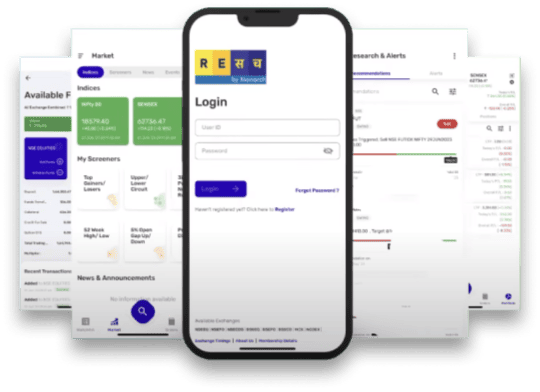
Empower your finances with ReSach – the stock trading apptrusted by serious investors. Whether you're planning to invest in stocks, explore commodity trading, or need a financial advisor to guide you, Resach brings it all under one platform.
Start trading today with ReSach and unlock seamless investing on the go.
"Nobody buys a farm based on whether they think it's going to rain next year.
Warren Buffett
Name of the Company has changed from Networth Stock Broking Limited to Monarch Networth Capital Limited upon Certification of Incorporation received from Registrar of Companies, Mumbai vide certificate dated 13th October, 2015.
If you are not satisfied with the resolution provided, you can lodge your complaint online at: https://scores.sebi.gov.in/link
In case of grievance client can log on to the SMART ODR Portal, if they are unsatisfied with the response provided by us. Your attention is drawn to the SEBI circular no. SEBI/HO/OIAE/OIAE_IAD-1/P/CIR/2023/131 dated July 31, 2023, on “Online Resolution of Disputes in the Indian Securities Market”.
Purchase of REs only gives buyer the right to participate in the ongoing Rights Issue of the concerned company by making an application with requisite application money or renounce the REs before the issue closes. REs which are neither subscribed by making an application with requisite application money nor renounced, on or before the Issue closing date shall lapse and shall be extinguished after the Issue closing date. Please check your dp account for further details.
Please do not share your online trading password with anyone as this could weaken the security of your account and lead to unauthorized trades or losses.
Monarch Networth Capital Limited (‘MNCL’) | CIN No.: L64990GJ1993PLC120014
Unit No. 803-804A, 8th Floor, X-Change Plaza, Block No. 53, Zone 5, Road-5E, Gift City, Gandhinagar - 382050, Gujarat
Ahmedabad
“Monarch House”, Opp Prahladbhai Patel garden, Near Ishwar Bhuvan, Commerce Six Roads, Navrangpura, Ahmedabad - 380009
Mumbai
Monarch Networth Capital Limited, G Block, Laxmi Tower, B Wing, 4th Floor, Bandra Kurla Complex, Bandra East, Mumbai - 400051.
Email for Grievance: grievances@mnclgroup.com
Investors are requested to note that Stock broker (Monarch Networth Capital Ltd) is permitted to receive money from investors through designated bank accounts only named as Up streaming Client Nodal Bank Account (USCNBA). Stock broker (Monarch Networth Capital Ltd) is also required to disclose these USCNB accounts to Stock Exchange. Hence, you are requested to use following USCNB accounts only (Click to View) for the purpose of dealings in your trading account with us. The details of these USCNB accounts are also displayed by Stock Exchanges on their website under “Know/ Locate your Stock Broker".
Mechanism for addressing grievances and information about SCORES.
Monarch Networth Capital IFSC Private Limited (Wholly owned subsidiary of Monarch Networth Capital Limited) is a Registered Fund Management Entity (Retail) having Registration No: IFSCA/FME/III/2025-26/169. Monarch India Growth Fund will be an open-ended Restricted Scheme (Non-Retail) construed as a Category III AIF under the IFSCA (Fund Management) Regulations, 2025. Monarch AIF is a Category III AIF having SEBI Registration No. IN/AIF3/20-21/0787. This material is for informational purposes only and is not intended as an offer or solicitation or investment advice to buy or sell securities. Investments are subject to market risks. The offering is made only through official scheme documents to eligible investors under GIFT IFSC regulations. Investors should read all documents carefully and consult their advisors before investing.
Mechanism for addressing grievances and information about SCORES.
Monarch Networth Capital Limited (‘MNCL’) | CIN No.: L64990GJ1993PLC120014
(As per LODR Regulations and Companies Act, 2013)
Contact information of the designated officials of the listed entity who are responsible for assisting and handling investor grievances : Mr. Nitesh Tanwar
Monarch Networth Capital Limited
Unit No. 803-804A, 8th Floor, X-Change Plaza, Block No. 53, Zone 5, Road-5E, Gift City, Gandhinagar - 382050, Gujarat
Ahmedabad
“Monarch House”, Opp Prahladbhai Patel garden, Near Ishwar Bhuvan, Commerce Six Roads, Navrangpura, Ahmedabad – 380009
Mumbai
Monarch Networth Capital Limited, G Block, Laxmi Tower, B Wing, 4th Floor, Bandra Kurla Complex, Bandra East, Mumbai - 400051.
Phone: 022 - 66476400 / 66476405
Email: cs@mnclgroup.com
Email for Grievance: cs@mnclgroup.com
Listing of Equity Shares on Stock Exchange at
BSE
NSE
(Formerly known as Link Intime India Private Limited)
For any queries related to broking please contact helpdesk@mnclgroup.com.
‘Investments in securities market are subject to market risks, read all the related documents carefully before investing.’




 Retail Broking
 Institutional Equities
 Investment Banking
 Alternative Investment Funds
 Wealth & Third-Party Products
 Debt Capital Market
 Partner Us


