Building wealth in the stock market is not limited to investing in hot stocks or capitalising on ongoing trends. Instead, successful long term investors focus on strategies that defy market volatility. The underlying principle here is growing a portfolio over years or decades.
There are several ways to do that. For example, some investors lock in a profit by selling their profitable assets and holding on non performing stocks. But this is just one way to do this. In this article, we have mentioned ways in which you can make huge profits from investment in the stock market in the long run.
Begin your investment in the stock market by doing a quick fundamental analysis. You can do it by deeply analysing factors like financial statements and industry trends. Indian markets are volatile, but regular SIP investments help average costs and avoid panic selling or overbuying. Success in equities comes from staying invested consistently over time, not from timing the market.
The fundamental analysis of stocks uses three sets of data:
Fundamental analysis of a company’s stocks also gives an idea of whether its shares are priced at a fair value. As a long-term investor, buy stocks below intrinsic value. If Infosys' true value is ₹1,200, buying at ₹1,000 offers a margin of safety. But if the intrinsic value is ₹950, buying at ₹1,000 isn’t wise. Some other examples of long term stocks are HDFC Bank, Asian Paints, Bajaj Finance and Nestle India.
Index funds tracking Nifty 50 or Sensex offer broad market exposure with low costs and passive management. Historically, Nifty 50 has returned about 11–12% annually. For most investors, index funds outperform stock picking and expensive mutual funds, making them a simple, effective way to build long-term wealth in India.
The right stock broker can help you mint profit from investment in the stock market. Therefore, you should always look for investment advisors who are licensed by SEBI. These individuals have the legal licence to offer you investment advice and also manage your portfolio. Unlike mutual funds or insurance agents, SEBI registered advisors work on fee models and they do not earn commissions by referring to financial products.
Other key benefits of hiring a SEBI registered investment advisor are as follows:
A SEBI Registered Investment Advisor has to assess a client’s risk profile in detail before providing any recommendations for investment in the stock market.
Equity or mutual funds come in handy when it comes to reducing risk for a long time. The stock broker invests in shares of different companies through equity funds thus diversifying your portfolio. This spreads the risk and leads to better long-term returns contrary to fixed deposits or debt-based funds.
Equity mutual funds offer attractive returns in the range of 12% to 15% to long-term investors. Thus, it is most suitable for long-term goals like retirement planning, children’s education, or wealth creation.
However, equity fund performance is subject to market fluctuations leading to high risk. One of the most effective strategies for investing in mutual funds is through Systematic Investment Plans (SIPs).
Starting early with investments also helps to get the power of compounding. For example, investing ₹5,000 monthly at a 12% annual return from age 25 to 55 can grow to over ₹1.75 crore. Starting just 10 years later may yield less than ₹50 lakh. The earlier you begin, the more time your returns have to generate their own returns, exponentially growing your wealth.
Here, investors have to contribute a fixed amount regularly on a monthly or annual basis. SIPs also benefit investors from rupee cost averaging for investment in the stock market.
Some examples of top performing equity funds are Motilal Oswal FlexiCap Fund Direct Plan Growth, HDFC Flexi Cap Fund, Invesco India Flexi Cap Fund, and WhiteOak Capital Flexi Cap Fund.
Portfolio Management Service should be on your action plan if you are pitching for a long position in the stock market. But what is it? PMS is the process of managing an individual’s investment with the idea of maximising their earnings. It works like a SWOT analysis for investments, matching options with your goals and risk level.
Designed primarily for HNIs (high net worth individuals), you can also avail of this service if you fall under any of the following brackets:
PMS is not only revered for its risk dyeing capabilities, but it also has some other advantages listed below:
Review your portfolio annually to ensure your asset allocation aligns with your risk profile and goals. For example, shift toward debt instruments like PPF as retirement approaches. Rebalance to prevent any asset class from dominating and maintain tax efficiency.
Alternative Investment Funds (AIFS) are privately held investment instruments which collect capital from selected investors. The experts invest the capital into non-traditional assets like real estate, private equity, venture capital etc.
These funds offer diversification and high return potential but carry more risk and require a longer lock-in period.
Unlike mutual funds, these investments in the stock market are not open to retail investors. AIFs are designed for HNIs with a minimum investment of Rs 1 crore. SEBI regulates AIFS under the AIF Regulations, 2012 and classifies them as companies, trusts or LLPs.
AIFs are divided into three categories as listed below:
| Category I AIF | Category II AIF | Category III AIF |
|---|---|---|
| Venture Capital Funds | Private Equity Funds | Hedge Funds |
| SME Funds | Debt Funds | Private investment in public |
| Infrastructure Funds | Real Estate Funds | Equity(PIPE) |
| Social Venture Funds | Derivatives-Based Funds |
Asset Management Services (AMS) manages investors' assets strategically thus helping them to create a balanced portfolio. The AMS experts carefully analyse market conditions and investment opportunities to allocate assets effectively. This approach ensures steady growth and protects against excessive risk. In turn, this helps investors to grow their wealth slowly. Additionally, it also safeguards investment in stock market against market volatility in the long run.
Disclaimer:
This blog is for educational and informational purposes only and should not be construed as an investment advice, an offer, or a solicitation to buy/sell any securities or financial products. The content does not endorse any specific services of Monarch Networth Capital Limited (MNCL) or its affiliates.
Readers are advised to consult their financial advisors or conduct independent research before making any investment decisions. Past performance is not indicative of future results. MNCL is a SEBI-registered intermediary (SEBI Registration No: INZ000008037). For further details, visit www.sebi.gov.in.



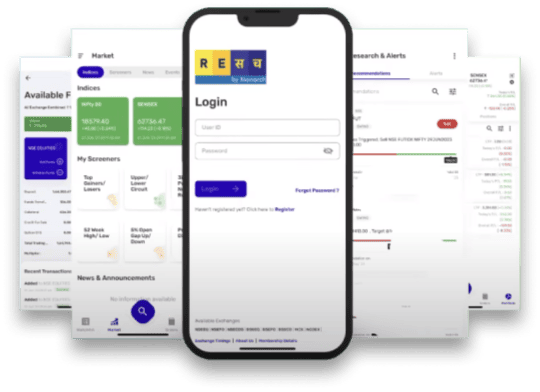
Empower your finances with ReSach – the stock trading apptrusted by serious investors. Whether you're planning to invest in stocks, explore commodity trading, or need a financial advisor to guide you, Resach brings it all under one platform.
Start trading today with ReSach and unlock seamless investing on the go.
Name of the Company has changed from Networth Stock Broking Limited to Monarch Networth Capital Limited upon Certification of Incorporation received from Registrar of Companies, Mumbai vide certificate dated 13th October, 2015.
If you are not satisfied with the resolution provided, you can lodge your complaint online at: https://scores.sebi.gov.in/link
In case of grievance client can log on to the SMART ODR Portal, if they are unsatisfied with the response provided by us. Your attention is drawn to the SEBI circular no. SEBI/HO/OIAE/OIAE_IAD-1/P/CIR/2023/131 dated July 31, 2023, on “Online Resolution of Disputes in the Indian Securities Market”.
Purchase of REs only gives buyer the right to participate in the ongoing Rights Issue of the concerned company by making an application with requisite application money or renounce the REs before the issue closes. REs which are neither subscribed by making an application with requisite application money nor renounced, on or before the Issue closing date shall lapse and shall be extinguished after the Issue closing date. Please check your dp account for further details.
Please do not share your online trading password with anyone as this could weaken the security of your account and lead to unauthorized trades or losses.
Monarch Networth Capital Limited (‘MNCL’) | CIN No.: L64990GJ1993PLC120014
Unit No. 803-804A, 8th Floor, X-Change Plaza, Block No. 53, Zone 5, Road-5E, Gift City, Gandhinagar - 382050, Gujarat
Ahmedabad
“Monarch House”, Opp Prahladbhai Patel garden, Near Ishwar Bhuvan, Commerce Six Roads, Navrangpura, Ahmedabad - 380009
Mumbai
Monarch Networth Capital Limited, G Block, Laxmi Tower, B Wing, 4th Floor, Bandra Kurla Complex, Bandra East, Mumbai - 400051.
Email for Grievance: grievances@mnclgroup.com
Investors are requested to note that Stock broker (Monarch Networth Capital Ltd) is permitted to receive money from investors through designated bank accounts only named as Up streaming Client Nodal Bank Account (USCNBA). Stock broker (Monarch Networth Capital Ltd) is also required to disclose these USCNB accounts to Stock Exchange. Hence, you are requested to use following USCNB accounts only (Click to View) for the purpose of dealings in your trading account with us. The details of these USCNB accounts are also displayed by Stock Exchanges on their website under “Know/ Locate your Stock Broker".
Mechanism for addressing grievances and information about SCORES.
Monarch Networth Capital IFSC Private Limited (Wholly owned subsidiary of Monarch Networth Capital Limited) is a Registered Fund Management Entity (Retail) having Registration No: IFSCA/FME/III/2025-26/169. Monarch India Growth Fund will be an open-ended Restricted Scheme (Non-Retail) construed as a Category III AIF under the IFSCA (Fund Management) Regulations, 2025. Monarch AIF is a Category III AIF having SEBI Registration No. IN/AIF3/20-21/0787. This material is for informational purposes only and is not intended as an offer or solicitation or investment advice to buy or sell securities. Investments are subject to market risks. The offering is made only through official scheme documents to eligible investors under GIFT IFSC regulations. Investors should read all documents carefully and consult their advisors before investing.
Mechanism for addressing grievances and information about SCORES.
Monarch Networth Capital Limited (‘MNCL’) | CIN No.: L64990GJ1993PLC120014
(As per LODR Regulations and Companies Act, 2013)
Contact information of the designated officials of the listed entity who are responsible for assisting and handling investor grievances : Mr. Nitesh Tanwar
Monarch Networth Capital Limited
Unit No. 803-804A, 8th Floor, X-Change Plaza, Block No. 53, Zone 5, Road-5E, Gift City, Gandhinagar - 382050, Gujarat
Ahmedabad
“Monarch House”, Opp Prahladbhai Patel garden, Near Ishwar Bhuvan, Commerce Six Roads, Navrangpura, Ahmedabad – 380009
Mumbai
Monarch Networth Capital Limited, G Block, Laxmi Tower, B Wing, 4th Floor, Bandra Kurla Complex, Bandra East, Mumbai - 400051.
Phone: 022 - 66476400 / 66476405
Email: cs@mnclgroup.com
Email for Grievance: cs@mnclgroup.com
Listing of Equity Shares on Stock Exchange at
BSE
NSE
(Formerly known as Link Intime India Private Limited)
For any queries related to broking please contact helpdesk@mnclgroup.com.
‘Investments in securities market are subject to market risks, read all the related documents carefully before investing.’