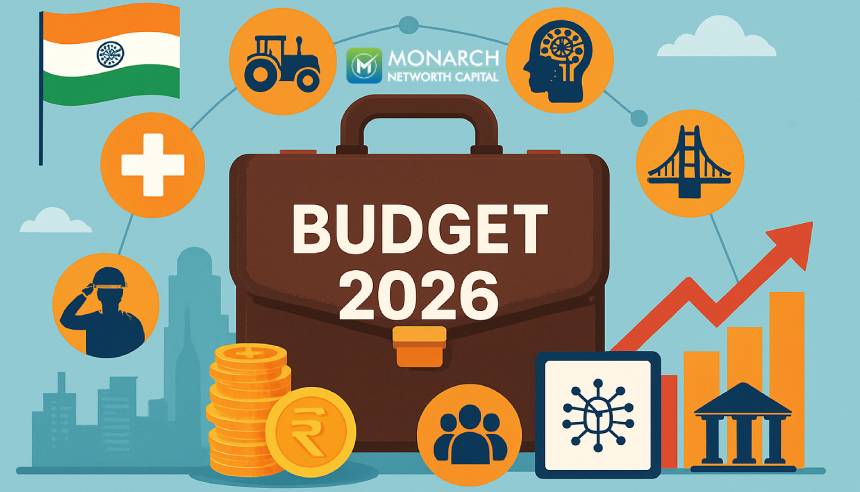
The Union Budget 2026 reinforces Government’s commitment of an inclusive and ‘Viksit Bharat’. A more structural and reform-oriented budget with focus around agriculture, health, infrastructure, and technology, defense (allocation at 1.5% of GDP) and banking remain at the center-stage. Push to support MSME, textile industry, Biopharma, fast growing and more promising AI & datacenters, education & youth, point to emphasis at Viksit Bharat. Further, with nominal GDP growth pegged at 10%; net-market borrowing at Rs11.7tn (in-line with market expectations) and fiscal deficit at 4.3% of GDP for FY27e points to fiscal-discipline and more than offsets the near-term impact around increase in STT on derivative products. Focus shifts to earnings, valuations, and external factors (India-US trade, currency and FII outflow). Our top-picks: KSB Ltd, TD Power, Ecos Mobility, Aurionpro Solutions, and Rashi Peripherals Ltd.
The Union Budget 2026, highlights the government’s emphasis on fiscal discipline by focusing on the quality of spending rather than its sheer size. Government's focus on fiscal consolidation remains on track, with the fiscal deficit reducing from 4.8% in FY25 to 4.4% in FY26RE, and a further moderation to 4.3% projected for FY27BE . Importantly, this disciplined approach is also reflected in a declining debt-to-GDP ratio, which has eased to 56.1% in FY26 and remains on a clear path toward the medium-term target of around 50% by FY31. On the revenue side, net tax receipts are projected to grow by 7.2% to Rs28.7tn for FY27BE (see table below). The growth in Centre expenditure is pegged at Rs43.5tn (up 5.8% YoY) for FY27e; defence budget upped to Rs5.94tn (vs. Rs5.67tn for FY26RE / Rs4.91tn as per FY26BE).
The proposed tax holiday for data centers is a structural positive for India’s digital infrastructure ecosystem, accelerating hyperscaler investments and AI-led workloads hosted domestically. Netweb Technologies stands to benefit directly from faster hyperscaler and captive data center capex in India, particularly for AI-first workloads. The co. is well positioned to capture incremental orders in high-performance compute, AI servers and storage as DC capex ramps up. Aurionpro Solutions benefits indirectly through its presence in data center design, consulting, and product manufacturing for DC-related applications; an increase in greenfield and brownfield data center projects should expand the company’s TAM. Rashi Peripherals and Redington stand to benefit from the volume-led expansion in data center hardware procurement, including servers, networking equipment, switches and routers, as new DC capacities are added in India. While we await better clarity, India AI mission the budget has proposed a corpus of Rs10bn towards Artificial Intelligence (AI) through India AI Mission for FY72E (this is half the proposed outlay of the previous year Rs20bn for FY26BE and lowered to Rs8bn as per FY26RE). Enhancement of Safe Harbor Threshold for IT Services from Rs 3bn to Rs 2bn reduces transfer pricing risk by eliminating margin disputes and prolonged litigation.
The Budget continues to strengthen India’s appeal as a global GCC hub by focusing on skill alignment, easier compliance and better investment facilitation, while also supporting data centre expansion through long-term tax incentives for global cloud players. The push to develop Tier-II and Tier-III cities under the City Economic Regions framework should help broaden the GCC footprint, reduce operating costs and sustain growth in high-value services. ECOS Mobility should get benefited given greater impetus at GCC ecosystem.
Public expenditure at Rs 12.2tn (+~8.8% YoY), underscores GOI commitment towards infrastructure / public welfare. The budget emphasized continuation/expansion of customs duty exemptions for capital goods in battery, nuclear power, aircraft and defence MRO, and infrastructure boosts like new DFCs, 20 national waterways, container-manufacturing scheme, and ship repair and seaplane schemes. We remain constructive on KSB ltd (play on nuclear power proliferation) and TD Power (data center build outs).
The Budget has extended the existing Basic Customs Duty (BCD) exemption on imported capital goods for lithium-ion battery manufacturing to include Battery Energy Storage Systems (BESS), with the duty reduced to Nil effective February 2, 2026. This measure, introduced under the energy transition framework, is aimed at lowering equipment costs and supporting domestic manufacturing of grid-scale energy storage. We see limited impact on Godawari Power (GPIL), as Phase-1 of its BESS plan involves importing complete battery packs with limited in-house manufacturing. The provision becomes relevant only in Phase-2, if GPIL decides to backward integrate into cell/pack manufacturing, where it could improve capex economics.
Click to download the full report on Union Budget 2026 by MNCL
The Union Budget 2026 focuses on fiscal discipline, infrastructure expansion, digital transformation, and sector-specific growth. Below are the most relevant investor questions based on MNCL’s institutional research.
The budget prioritizes fiscal consolidation, quality spending, and structural reforms, improving macro stability and strengthening long-term earnings visibility across key sectors.
The fiscal deficit is projected at 4.3% of GDP for FY27 with controlled borrowing, reinforcing discipline and supporting lower macro risk and stable capital flows.
Infrastructure, defense, capital goods, AI & data centers, digital infrastructure, and sectors linked to public capex and technology adoption are key beneficiaries.
Tax incentives and policy support for data centers, along with AI mission funding, are expected to accelerate hyperscaler investments and domestic digital infrastructure growth.
MNCL’s preferred picks include KSB Ltd, TD Power Systems, Ecos Mobility, Aurionpro Solutions, and Rashi Peripherals based on sector tailwinds and earnings visibility.
Disclaimer: - You are advised to read our disclaimer here: https://www.mnclgroup.com/disclaimers



Empower your finances with ReSach – the stock trading apptrusted by serious investors. Whether you're planning to invest in stocks, explore commodity trading, or need a financial advisor to guide you, Resach brings it all under one platform.
Start trading today with ReSach and unlock seamless investing on the go.
Name of the Company has changed from Networth Stock Broking Limited to Monarch Networth Capital Limited upon Certification of Incorporation received from Registrar of Companies, Mumbai vide certificate dated 13th October, 2015.
If you are not satisfied with the resolution provided, you can lodge your complaint online at: https://scores.sebi.gov.in/link
In case of grievance client can log on to the SMART ODR Portal, if they are unsatisfied with the response provided by us. Your attention is drawn to the SEBI circular no. SEBI/HO/OIAE/OIAE_IAD-1/P/CIR/2023/131 dated July 31, 2023, on “Online Resolution of Disputes in the Indian Securities Market”.
Purchase of REs only gives buyer the right to participate in the ongoing Rights Issue of the concerned company by making an application with requisite application money or renounce the REs before the issue closes. REs which are neither subscribed by making an application with requisite application money nor renounced, on or before the Issue closing date shall lapse and shall be extinguished after the Issue closing date. Please check your dp account for further details.
Please do not share your online trading password with anyone as this could weaken the security of your account and lead to unauthorized trades or losses.
Monarch Networth Capital Limited (‘MNCL’) | CIN No.: L64990GJ1993PLC120014
Unit No. 803-804A, 8th Floor, X-Change Plaza, Block No. 53, Zone 5, Road-5E, Gift City, Gandhinagar - 382050, Gujarat
Ahmedabad
“Monarch House”, Opp Prahladbhai Patel garden, Near Ishwar Bhuvan, Commerce Six Roads, Navrangpura, Ahmedabad - 380009
Mumbai
Monarch Networth Capital Limited, G Block, Laxmi Tower, B Wing, 4th Floor, Bandra Kurla Complex, Bandra East, Mumbai - 400051.
Email for Grievance: grievances@mnclgroup.com
Investors are requested to note that Stock broker (Monarch Networth Capital Ltd) is permitted to receive money from investors through designated bank accounts only named as Up streaming Client Nodal Bank Account (USCNBA). Stock broker (Monarch Networth Capital Ltd) is also required to disclose these USCNB accounts to Stock Exchange. Hence, you are requested to use following USCNB accounts only (Click to View) for the purpose of dealings in your trading account with us. The details of these USCNB accounts are also displayed by Stock Exchanges on their website under “Know/ Locate your Stock Broker".
Mechanism for addressing grievances and information about SCORES.
Monarch Networth Capital IFSC Private Limited (Wholly owned subsidiary of Monarch Networth Capital Limited) is a Registered Fund Management Entity (Retail) having Registration No: IFSCA/FME/III/2025-26/169. Monarch India Growth Fund will be an open-ended Restricted Scheme (Non-Retail) construed as a Category III AIF under the IFSCA (Fund Management) Regulations, 2025. Monarch AIF is a Category III AIF having SEBI Registration No. IN/AIF3/20-21/0787. This material is for informational purposes only and is not intended as an offer or solicitation or investment advice to buy or sell securities. Investments are subject to market risks. The offering is made only through official scheme documents to eligible investors under GIFT IFSC regulations. Investors should read all documents carefully and consult their advisors before investing.
Mechanism for addressing grievances and information about SCORES.
Monarch Networth Capital Limited (‘MNCL’) | CIN No.: L64990GJ1993PLC120014
(As per LODR Regulations and Companies Act, 2013)
Contact information of the designated officials of the listed entity who are responsible for assisting and handling investor grievances : Mr. Nitesh Tanwar
Monarch Networth Capital Limited
Unit No. 803-804A, 8th Floor, X-Change Plaza, Block No. 53, Zone 5, Road-5E, Gift City, Gandhinagar - 382050, Gujarat
Ahmedabad
“Monarch House”, Opp Prahladbhai Patel garden, Near Ishwar Bhuvan, Commerce Six Roads, Navrangpura, Ahmedabad – 380009
Mumbai
Monarch Networth Capital Limited, G Block, Laxmi Tower, B Wing, 4th Floor, Bandra Kurla Complex, Bandra East, Mumbai - 400051.
Phone: 022 - 66476400 / 66476405
Email: cs@mnclgroup.com
Email for Grievance: cs@mnclgroup.com
Listing of Equity Shares on Stock Exchange at
BSE
NSE
(Formerly known as Link Intime India Private Limited)
For any queries related to broking please contact helpdesk@mnclgroup.com.
‘Investments in securities market are subject to market risks, read all the related documents carefully before investing.’