Want to grow your money without watching charts all day? Swing trading offers a balanced trading strategy perfect for working professionals or beginner traders. This guide will show you how swing trading works, key tools you’ll need, and how to start profitably—step-by-step.
It’s an entry point for beginners, helping them learn chart reading, trend analysis and risk management with flexible hours. In this guide, you’ll learn what swing trading is, its pros and cons, key tools, strategies and how to pick the right stocks.
Swing trading is a short to medium term trading style where traders aim to capture price movements or swings in a stock, commodity or index over a few days to a few weeks. The main idea is to identify a stock that might move in a certain direction, enter at a good price, hold the position while the move plays out and exit before the trend reverses.
Unlike intraday trading, which requires constant monitoring and closing positions the same day, swing trading allows you to hold trades overnight and even for multiple weeks. Traders mostly rely on technical analysis, using chart patterns, support & resistance levels and momentum indicators to spot opportunities. It’s popular because it balances time, effort, and returns without needing to watch the screen all day.
Here are some advantages and disadvantages of swing trading.
Less time consuming: No need to watch markets all day.
Flexibility: Suitable for people with jobs or other commitments.
Captures bigger moves: Can benefit from multi-day trends rather than tiny intraday fluctuations.
Lower transaction costs: Fewer trades compared to day trading.
Overnight risk: Global news, company announcements, or macro events can cause gaps against your position.
Requires patience: Trades may take days or even weeks to reach their targets.
Market volatility: Unexpected events can reverse trends.
Need for analysis skills: Requires understanding of technical and fundamental indicators.
Ride the Swings Profitably – Open your trading account and start executing swing setups seamlessly with ReSach.
Using multiple timeframes and chart types helps swing traders make better decisions.
Both are short term trading styles, but differ in approach:
| Criteria | Swing Trading | Day Trading |
|---|---|---|
| Holding period | Few days to weeks | Minutes to hours |
| Screen time | Few hours weekly | Full-day monitoring |
| Risk | Overnight exposure | No overnight exposure |
| Number of trades | Fewer trades | Many trades per day |
| Capital requirement | Moderate | Higher for margin and quick execution |
Swing trading suits those who want flexibility, while day trading is for people who can actively monitor markets all day.
To trade effectively, you need the right tools:
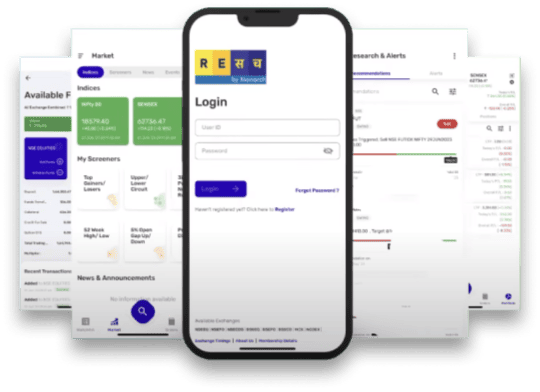
Learn swing trading? Now trade it. Get ReSach by Monarch and start today.
Open Stock Trading A/C in 2 Mins
Below are some common swing trading strategies traders can explore:
Choosing the right stocks is crucial. Focus on these key factors:
Stock screeners can help you spot perfect setups for swing trades.
Swing trading offers perfect middle ground between day trading and long-term investing. It allows beginners to understand price action, learn chart reading and develop discipline without dedicating their entire day to markets. Beginners should start with a demo account or small capital, practice spotting trends, and build a clear plan with proper entry, exit and stop loss. With consistent learning and proper risk management, swing trading can become a reliable way to grow wealth over time.
Turn Strategy into Action – Spot swing opportunities and execute trades flawlessly with ReSach.
Open Your Demat Account Now
Disclaimer: This blog is for educational purposes only and does not constitute investment advice, an offer to buy/sell securities, or a recommendation. Past performance is not indicative of future results. Investors should consult a SEBI-registered advisor before making decisions. Mention of third-party entities is for illustration only and not an endorsement. Readers are advised to consult their financial advisors or conduct independent research before making any investment decisions. Past performance is not indicative of future results. MNCL is a SEBI-registered intermediary (SEBI Registration No: INZ000008037). For further details, visit www.sebi.gov.in.



Empower your finances with ReSach – the stock trading apptrusted by serious investors. Whether you're planning to invest in stocks, explore commodity trading, or need a financial advisor to guide you, Resach brings it all under one platform.
Start trading today with ReSach and unlock seamless investing on the go.
Name of the Company has changed from Networth Stock Broking Limited to Monarch Networth Capital Limited upon Certification of Incorporation received from Registrar of Companies, Mumbai vide certificate dated 13th October, 2015.
If you are not satisfied with the resolution provided, you can lodge your complaint online at: https://scores.sebi.gov.in/link
In case of grievance client can log on to the SMART ODR Portal, if they are unsatisfied with the response provided by us. Your attention is drawn to the SEBI circular no. SEBI/HO/OIAE/OIAE_IAD-1/P/CIR/2023/131 dated July 31, 2023, on “Online Resolution of Disputes in the Indian Securities Market”.
Purchase of REs only gives buyer the right to participate in the ongoing Rights Issue of the concerned company by making an application with requisite application money or renounce the REs before the issue closes. REs which are neither subscribed by making an application with requisite application money nor renounced, on or before the Issue closing date shall lapse and shall be extinguished after the Issue closing date. Please check your dp account for further details.
Please do not share your online trading password with anyone as this could weaken the security of your account and lead to unauthorized trades or losses.
Monarch Networth Capital Limited (‘MNCL’) | CIN No.: L64990GJ1993PLC120014
Unit No. 803-804A, 8th Floor, X-Change Plaza, Block No. 53, Zone 5, Road-5E, Gift City, Gandhinagar - 382050, Gujarat
Ahmedabad
“Monarch House”, Opp Prahladbhai Patel garden, Near Ishwar Bhuvan, Commerce Six Roads, Navrangpura, Ahmedabad - 380009
Mumbai
Monarch Networth Capital Limited, G Block, Laxmi Tower, B Wing, 4th Floor, Bandra Kurla Complex, Bandra East, Mumbai - 400051.
Email for Grievance: grievances@mnclgroup.com
Investors are requested to note that Stock broker (Monarch Networth Capital Ltd) is permitted to receive money from investors through designated bank accounts only named as Up streaming Client Nodal Bank Account (USCNBA). Stock broker (Monarch Networth Capital Ltd) is also required to disclose these USCNB accounts to Stock Exchange. Hence, you are requested to use following USCNB accounts only (Click to View) for the purpose of dealings in your trading account with us. The details of these USCNB accounts are also displayed by Stock Exchanges on their website under “Know/ Locate your Stock Broker".
Mechanism for addressing grievances and information about SCORES.
Monarch Networth Capital IFSC Private Limited (Wholly owned subsidiary of Monarch Networth Capital Limited) is a Registered Fund Management Entity (Retail) having Registration No: IFSCA/FME/III/2025-26/169. Monarch India Growth Fund will be an open-ended Restricted Scheme (Non-Retail) construed as a Category III AIF under the IFSCA (Fund Management) Regulations, 2025. Monarch AIF is a Category III AIF having SEBI Registration No. IN/AIF3/20-21/0787. This material is for informational purposes only and is not intended as an offer or solicitation or investment advice to buy or sell securities. Investments are subject to market risks. The offering is made only through official scheme documents to eligible investors under GIFT IFSC regulations. Investors should read all documents carefully and consult their advisors before investing.
Mechanism for addressing grievances and information about SCORES.
Monarch Networth Capital Limited (‘MNCL’) | CIN No.: L64990GJ1993PLC120014
(As per LODR Regulations and Companies Act, 2013)
Contact information of the designated officials of the listed entity who are responsible for assisting and handling investor grievances : Mr. Nitesh Tanwar
Monarch Networth Capital Limited
Unit No. 803-804A, 8th Floor, X-Change Plaza, Block No. 53, Zone 5, Road-5E, Gift City, Gandhinagar - 382050, Gujarat
Ahmedabad
“Monarch House”, Opp Prahladbhai Patel garden, Near Ishwar Bhuvan, Commerce Six Roads, Navrangpura, Ahmedabad – 380009
Mumbai
Monarch Networth Capital Limited, G Block, Laxmi Tower, B Wing, 4th Floor, Bandra Kurla Complex, Bandra East, Mumbai - 400051.
Phone: 022 - 66476400 / 66476405
Email: cs@mnclgroup.com
Email for Grievance: cs@mnclgroup.com
Listing of Equity Shares on Stock Exchange at
BSE
NSE
(Formerly known as Link Intime India Private Limited)
For any queries related to broking please contact helpdesk@mnclgroup.com.
‘Investments in securities market are subject to market risks, read all the related documents carefully before investing.’