So you’ve been trading for a while. By now you know your way around charts, have dabbled in intraday trading or swing trading, and feel ready to level up. You’re not looking for generic advice anymore; you want smarter strategies, tighter risk control, and tools that actually match your growing skill set.
This guide is for traders who are beyond the basics and ready to move with more structure. It will walk you through advanced trading strategies, risk frameworks, market psychology upgrades, and the kind of tools that support serious execution.
This style involves combining multiple option legs, calls and puts at different strike prices, to create trades with limited risk and defined outcomes.
Here are some specific strategies under this category:
Example: You expect Nifty to stay between 21,000–22,000 for the week. An iron condor lets you collect a premium as long as the price stays within that range.
Why it’s Advanced: Requires understanding of option Greeks and implied volatility.
Scalping trading involves taking multiple small trades to profit from short-term price blips. Advanced scalpers use order book dynamics and tape reading to spot price shifts before they play out on the chart.
Example: At a support level, rising bid sizes show buyer aggression—so you enter long for a quick 5–10 point move.
Why it’s Advanced: Demands precision, speed, and access to real-time depth data.
Algorithmic trading involves creating rule-based trading systems that can be coded, tested, and automated. Algorithms remove emotional decision-making and allow for high-speed execution across multiple instruments.
Example: You create a bot that enters trades when the Relative Strength Index (RSI) drops below 30 and a moving average crossover occurs—then automatically exits based on trailing stop-loss.
Why it’s Advanced: Requires coding skills, backtesting, and robust logic.
Quant trading is data-driven. It relies on statistics, probability, and correlation, not gut feelings. It shines when you're trading large samples and want a mathematical edge.
Here are some specific strategies:
Pairs Trading (Long- Short): You identify two correlated stocks and trade their divergence, shorting the one that outperformed and buying the laggard.
Or buying the outperformer and shorting the leggard, depending on your trading strategy.
Example: You go long on a stock that has dropped 5% below its 20-day average, expecting a bounce.
Why it’s Advanced: Requires understanding of statistical relationships and data modelling.
This strategy revolves around scheduled catalysts, like earnings, policy decisions, or macro data, that can cause volatility spikes. Common strategies under this:
Example: Before an RBI announcement, you buy a straddle on Bank Nifty, profiting if it moves sharply, regardless of direction.
Why it’s Advanced: Needs sharp catalyst awareness, fast execution, and strong risk planning.
Best for: Traders who understand derivatives and want defined-risk income strategies or volatility plays
Avoid if: You don't understand option greeks and time decays
Best for: Traders with real-time access, fast reflexes, and high screen time
Avoid if: You can’t monitor the market actively during the day
Best for: Traders who enjoy coding, backtesting, and automating logic
Avoid if: You prefer discretionary, manual trading
Best for: Data-driven minds who want to test statistical edges over large trade samples
Avoid if: You’re looking for fast, visual setups
Best for: Strategists who track earnings, news, and macro themes and want volatility setups
Avoid if: You struggle to trade during fast-moving or uncertain environments
The more complex your strategy, the more critical your risk discipline. Here are key risk management frameworks to consider:
At the advanced level, success has less to do with being “right” and more to do with managing uncertainty consistently.
Key psychological points to note for advanced traders:
Read our detailed guide if you want a deeper dive into trading psychology?
Your edge isn’t just in your strategy; it’s also in your setup. At the advanced level, you need tools that support faster execution, deeper analysis, and clean automation.
Here’s how to build a smart trading stack:
Advanced trading isn’t about making wild calls or stacking fancy indicators. It’s about building systems that work consistently, rationally, and under pressure. Whether you’re refining your edge with multi-leg option strategies or automating your logic, the goal remains the same: clarity over chaos.
The tools, strategies, and mindset covered here are meant to evolve with you. Choose what aligns with your temperament and strategy, test it, and systemise it. Algorithmic trading strategies require SEBI approval for deployment in live markets.
Disclaimer
The strategies discussed are for educational purposes only. Past performance is not indicative of future results. Trading involves risk of loss. Trading in securities, derivatives, or other financial instruments carries significant risk. Consult a financial advisor before making any decisions. This content is not an offer, recommendation, or solicitation for any product/service. For tailored advice, consult a SEBI-registered Investment adviser.



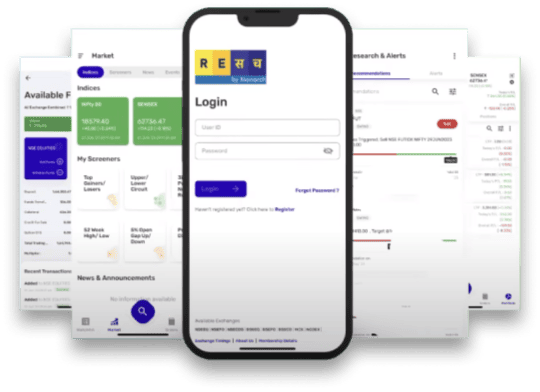
Empower your finances with ReSach – the stock trading apptrusted by serious investors. Whether you're planning to invest in stocks, explore commodity trading, or need a financial advisor to guide you, Resach brings it all under one platform.
Start trading today with ReSach and unlock seamless investing on the go.
Name of the Company has changed from Networth Stock Broking Limited to Monarch Networth Capital Limited upon Certification of Incorporation received from Registrar of Companies, Mumbai vide certificate dated 13th October, 2015.
If you are not satisfied with the resolution provided, you can lodge your complaint online at: https://scores.sebi.gov.in/link
In case of grievance client can log on to the SMART ODR Portal, if they are unsatisfied with the response provided by us. Your attention is drawn to the SEBI circular no. SEBI/HO/OIAE/OIAE_IAD-1/P/CIR/2023/131 dated July 31, 2023, on “Online Resolution of Disputes in the Indian Securities Market”.
Purchase of REs only gives buyer the right to participate in the ongoing Rights Issue of the concerned company by making an application with requisite application money or renounce the REs before the issue closes. REs which are neither subscribed by making an application with requisite application money nor renounced, on or before the Issue closing date shall lapse and shall be extinguished after the Issue closing date. Please check your dp account for further details.
Please do not share your online trading password with anyone as this could weaken the security of your account and lead to unauthorized trades or losses.
Monarch Networth Capital Limited (‘MNCL’) | CIN No.: L64990GJ1993PLC120014
Unit No. 803-804A, 8th Floor, X-Change Plaza, Block No. 53, Zone 5, Road-5E, Gift City, Gandhinagar - 382050, Gujarat
Ahmedabad
“Monarch House”, Opp Prahladbhai Patel garden, Near Ishwar Bhuvan, Commerce Six Roads, Navrangpura, Ahmedabad - 380009
Mumbai
Monarch Networth Capital Limited, G Block, Laxmi Tower, B Wing, 4th Floor, Bandra Kurla Complex, Bandra East, Mumbai - 400051.
Email for Grievance: grievances@mnclgroup.com
Investors are requested to note that Stock broker (Monarch Networth Capital Ltd) is permitted to receive money from investors through designated bank accounts only named as Up streaming Client Nodal Bank Account (USCNBA). Stock broker (Monarch Networth Capital Ltd) is also required to disclose these USCNB accounts to Stock Exchange. Hence, you are requested to use following USCNB accounts only (Click to View) for the purpose of dealings in your trading account with us. The details of these USCNB accounts are also displayed by Stock Exchanges on their website under “Know/ Locate your Stock Broker".
Mechanism for addressing grievances and information about SCORES.
Monarch Networth Capital IFSC Private Limited (Wholly owned subsidiary of Monarch Networth Capital Limited) is a Registered Fund Management Entity (Retail) having Registration No: IFSCA/FME/III/2025-26/169. Monarch India Growth Fund will be an open-ended Restricted Scheme (Non-Retail) construed as a Category III AIF under the IFSCA (Fund Management) Regulations, 2025. Monarch AIF is a Category III AIF having SEBI Registration No. IN/AIF3/20-21/0787. This material is for informational purposes only and is not intended as an offer or solicitation or investment advice to buy or sell securities. Investments are subject to market risks. The offering is made only through official scheme documents to eligible investors under GIFT IFSC regulations. Investors should read all documents carefully and consult their advisors before investing.
Mechanism for addressing grievances and information about SCORES.
Monarch Networth Capital Limited (‘MNCL’) | CIN No.: L64990GJ1993PLC120014
(As per LODR Regulations and Companies Act, 2013)
Contact information of the designated officials of the listed entity who are responsible for assisting and handling investor grievances : Mr. Nitesh Tanwar
Monarch Networth Capital Limited
Unit No. 803-804A, 8th Floor, X-Change Plaza, Block No. 53, Zone 5, Road-5E, Gift City, Gandhinagar - 382050, Gujarat
Ahmedabad
“Monarch House”, Opp Prahladbhai Patel garden, Near Ishwar Bhuvan, Commerce Six Roads, Navrangpura, Ahmedabad – 380009
Mumbai
Monarch Networth Capital Limited, G Block, Laxmi Tower, B Wing, 4th Floor, Bandra Kurla Complex, Bandra East, Mumbai - 400051.
Phone: 022 - 66476400 / 66476405
Email: cs@mnclgroup.com
Email for Grievance: cs@mnclgroup.com
Listing of Equity Shares on Stock Exchange at
BSE
NSE
(Formerly known as Link Intime India Private Limited)
For any queries related to broking please contact helpdesk@mnclgroup.com.
‘Investments in securities market are subject to market risks, read all the related documents carefully before investing.’