
Swing trading is one of the ways to participate in the stock market without tracking prices every minute. It works well for traders who want short-term opportunities but cannot commit to full-time intraday trading.
This blog explains what swing trading is, how it fits among other beginner-friendly trading strategies, and how traders can manage entries, exits and position sizing with discipline.
Swing trading is a short-term trading strategy where traders aim to capture price movements that play out over a few days to a few weeks. These price movements or “swings,” usually happen within a broader trend.
Swing traders rely mainly on technical analysis. Traders look for stocks showing strong momentum, clear trends or breakout patterns. While price action is primary, understanding how to analyse stocks using fundamentals and market trends can help filter for higher-quality swing setups. Once a trade is entered, the focus shifts to risk control rather than prediction.
Unlike intraday trading, positions are carried overnight. Unlike long-term investing, the focus is on price momentum rather than business fundamentals. This balance makes swing trading for beginners easier to understand & execute.
Knowing when to enter a swing trade is critical. Good entries reduce risk and improve reward potential.
One popular method is the breakout trading strategy. In this setup, traders enter when stock breaks above a well defined resistance level with strong volume. But volume confirmation is important because it shows genuine participation, not a false move.
Another commonly used method is the pullback trading strategy. Here, traders wait for a stock in an uptrend to correct slightly and then enter near support. This offers better risk reward compared to chasing prices.
These entry techniques are widely used in short-term trading strategies because they align trades with market momentum.
Exits matter more than entries in swing trading.
But a proper swing trading exit strategy always includes a predefined stop-loss and a profit target. Knowing what a stop-loss is and why it is crucial is the first line of defense to protect capital if the trade goes wrong. Profit targets help lock gains before momentum fades.
Setting a stop-loss for swing trades is usually done below a recent support level or based on volatility. Profit targets for swing trading are often placed at the next resistance level or using a fixed risk-reward ratio such as 1:2.
Many traders focus only on stock selection but ignore capital management. This is where most losses happen. Swing trading position sizing defines how many shares you should buy in a single trade.
The approach should be simple, one bad trade should never damage your entire trading capital. Most professionals follow a rule of risking 1-2% per trade.
The position sizing formula is straightforward.
This method helps in calculating shares per trade logically instead of emotionally. Many traders also use a position size calculator to avoid manual errors.
Once your position size is calculated, executing the trade efficiently requires knowing the key differences between market orders and limit orders.
Technical analysis for swing trading goes beyond basic indicators. It helps traders understand market structure, trend strength and price behaviour across multiple timeframes. This allows precise entry, exit and stop-loss placement which is critical for consistent swing trading performance.
Key swing trading indicators such as moving averages, RSI and MACD are used to identify trend alignment, momentum shifts and early signs of exhaustion. When these indicators align with swing trading chart patterns like flags, triangles and double bottoms, traders gain stronger confirmation of breakout validity and risk–reward potential.
Traders also use ATR indicator for swing trading to measure market volatility and show how much stock typically moves in day.
Traders often review a stock market technical analysis weekly wrap to identify which sectors are currently exhibiting the momentum required for these setups.
Swing trading is not about predicting the market. But it is about risk control, rule based execution and consistency over time. Profitable swing trading comes from aligning entries, exits and position sizing, not from chasing perfect setups. If you want to learn how to swing trade stocks profitably, discipline matters more than indicators.
Stay ahead of market trends with our latest technical analysis reports and research insights.
Disclaimer: Investments in the securities market are subject to market risks, read all the related documents carefully before investing. The information provided in this material is only for education purposes and should not be used for public distribution and must not be reproduced or redistributed to any other person. One must consult their legal, tax and financial advisors before taking any investment related decisions. https://www.mnclgroup.com/research-disclaimer



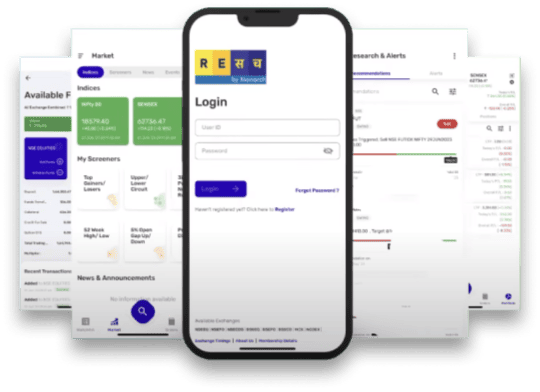
Empower your finances with ReSach – the stock trading apptrusted by serious investors. Whether you're planning to invest in stocks, explore commodity trading, or need a financial advisor to guide you, Resach brings it all under one platform.
Start trading today with ReSach and unlock seamless investing on the go.
Name of the Company has changed from Networth Stock Broking Limited to Monarch Networth Capital Limited upon Certification of Incorporation received from Registrar of Companies, Mumbai vide certificate dated 13th October, 2015.
If you are not satisfied with the resolution provided, you can lodge your complaint online at: https://scores.sebi.gov.in/link
In case of grievance client can log on to the SMART ODR Portal, if they are unsatisfied with the response provided by us. Your attention is drawn to the SEBI circular no. SEBI/HO/OIAE/OIAE_IAD-1/P/CIR/2023/131 dated July 31, 2023, on “Online Resolution of Disputes in the Indian Securities Market”.
Purchase of REs only gives buyer the right to participate in the ongoing Rights Issue of the concerned company by making an application with requisite application money or renounce the REs before the issue closes. REs which are neither subscribed by making an application with requisite application money nor renounced, on or before the Issue closing date shall lapse and shall be extinguished after the Issue closing date. Please check your dp account for further details.
Please do not share your online trading password with anyone as this could weaken the security of your account and lead to unauthorized trades or losses.
Monarch Networth Capital Limited (‘MNCL’) | CIN No.: L64990GJ1993PLC120014
Unit No. 803-804A, 8th Floor, X-Change Plaza, Block No. 53, Zone 5, Road-5E, Gift City, Gandhinagar - 382050, Gujarat
Ahmedabad
“Monarch House”, Opp Prahladbhai Patel garden, Near Ishwar Bhuvan, Commerce Six Roads, Navrangpura, Ahmedabad - 380009
Mumbai
Monarch Networth Capital Limited, G Block, Laxmi Tower, B Wing, 4th Floor, Bandra Kurla Complex, Bandra East, Mumbai - 400051.
Email for Grievance: grievances@mnclgroup.com
Investors are requested to note that Stock broker (Monarch Networth Capital Ltd) is permitted to receive money from investors through designated bank accounts only named as Up streaming Client Nodal Bank Account (USCNBA). Stock broker (Monarch Networth Capital Ltd) is also required to disclose these USCNB accounts to Stock Exchange. Hence, you are requested to use following USCNB accounts only (Click to View) for the purpose of dealings in your trading account with us. The details of these USCNB accounts are also displayed by Stock Exchanges on their website under “Know/ Locate your Stock Broker".
Mechanism for addressing grievances and information about SCORES.
Monarch Networth Capital IFSC Private Limited (Wholly owned subsidiary of Monarch Networth Capital Limited) is a Registered Fund Management Entity (Retail) having Registration No: IFSCA/FME/III/2025-26/169. Monarch India Growth Fund will be an open-ended Restricted Scheme (Non-Retail) construed as a Category III AIF under the IFSCA (Fund Management) Regulations, 2025. Monarch AIF is a Category III AIF having SEBI Registration No. IN/AIF3/20-21/0787. This material is for informational purposes only and is not intended as an offer or solicitation or investment advice to buy or sell securities. Investments are subject to market risks. The offering is made only through official scheme documents to eligible investors under GIFT IFSC regulations. Investors should read all documents carefully and consult their advisors before investing.
Mechanism for addressing grievances and information about SCORES.
Monarch Networth Capital Limited (‘MNCL’) | CIN No.: L64990GJ1993PLC120014
(As per LODR Regulations and Companies Act, 2013)
Contact information of the designated officials of the listed entity who are responsible for assisting and handling investor grievances : Mr. Nitesh Tanwar
Monarch Networth Capital Limited
Unit No. 803-804A, 8th Floor, X-Change Plaza, Block No. 53, Zone 5, Road-5E, Gift City, Gandhinagar - 382050, Gujarat
Ahmedabad
“Monarch House”, Opp Prahladbhai Patel garden, Near Ishwar Bhuvan, Commerce Six Roads, Navrangpura, Ahmedabad – 380009
Mumbai
Monarch Networth Capital Limited, G Block, Laxmi Tower, B Wing, 4th Floor, Bandra Kurla Complex, Bandra East, Mumbai - 400051.
Phone: 022 - 66476400 / 66476405
Email: cs@mnclgroup.com
Email for Grievance: cs@mnclgroup.com
Listing of Equity Shares on Stock Exchange at
BSE
NSE
(Formerly known as Link Intime India Private Limited)
For any queries related to broking please contact helpdesk@mnclgroup.com.
‘Investments in securities market are subject to market risks, read all the related documents carefully before investing.’