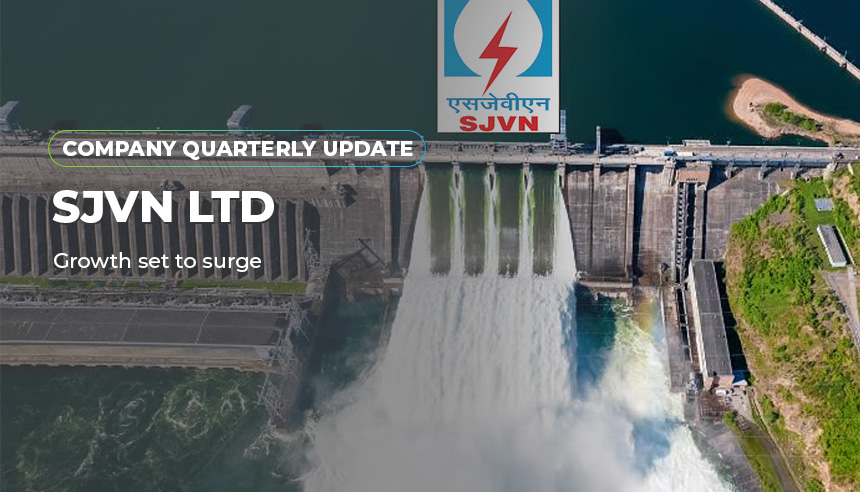
We upgrade SJVN to Buy and raise Target Price to Rs 110 (from Rs 102) due to valuation rollover. H2-FY26 is poised for a step-up with expected full commissioning of Buxar TPP, Bikaner SPP, and select other solar projects, driving capacity to ~5.0 GW (vs 3.1 GW currently). Its other under-construction projects should keep the growth momentum high for the next 2 years as well. The company is now more focused on execution rather than aggressive ramp up of their pipeline portfolio. Sector fundamentals remain supportive, with SJVN playing a strategic role in the GoI’s renewable energy ambitions. We have kept our estimates unchanged and project revenue, EBITDA, and PAT to grow at a CAGR of ~55% over FY25-FY28E, underpinned by capacity additions.
Q2FY26 revenue of Rs 10,324 was flat YoY, and 1HFY26 revenue of Rs 19,499 mn was up 3 % YoY. Total installed capacity rose to 3,147 MW, up 28% YoY, but power generated for 1HFY26 was up by only 6.3% YoY. EBITDA margin was 260 bps YoY, but PAT was down by 28% YoY due to higher depreciation and finance costs. Usually, Q2 is a cyclically strong quarter for the hydropower generation in India but this time around the extended monsoon period led to high silt deposition which required more operational maintenance culminating into lower plant availability factor. Additionally, capacity utilization of solar power plants would also have been cyclically low during this period. Capacity utilization for H1FY26 was 69% vs H1FY25’s 82%.
Buxar Unit 1 (660 MW, TPP) trial test is successfully done and will soon get commissioned while Unit 2 (660 MW, TPP) will see commissioning in another 2-3 months. Full commissioning of Bikaner SPP (total 1000 MW, of which 320 MW is under construction) is expected by Q3/Q4 FY26 while Arun III (900 MW, HEP) construction is on track for completion by Q3 FY27. Including Buxar unit 2, the total capacity under construction as of Q2 end is 5,091 MW versus current installed capacity of 3,147 MW (63% hydro and 37% solar and wind). We have assumed a year end installed capacity of 5.0 GW and 7.5 GW by FY26 / FY27, respectively. These do not include the 3 HPP projects which are currently in conflict with GoHP, viz., Luhri (210 MW), Dhaulasidh (66 MW), and Sunni (382 MW).
Our TP is derived using an average of indicative fair value applying a 15.0x P/E and 10.0x EV/EBITDA (unchanged) in-line with NHPC’s forward valuations. Applying these multiples to our September 2027E EPS and EBITDA, we arrive at a TP of Rs 110, implied upside of 31%. We have moved our rating to Buy from Accumulate reflecting step up in growth and operating leverage going forward. Downside risks to our target price may emanate from a further delay in project completions.
Company website: https://sjvn.nic.in/
| Rating | BUY |
|---|---|
| CMP | INR 84 |
| Target Price | INR 110 |
| Upside | 31% |

Click to download the full SJVN Ltd Company Update
SJVN has been upgraded to a BUY rating with a revised target price of Rs 110, implying an upside of 31% from the current market price of Rs 84.
The positive outlook is driven by expected full commissioning of key thermal and solar projects, which is likely to increase installed capacity and support strong growth over the next two years.
As of Q2FY26, SJVN’s installed capacity stood at 3,147 MW, comprising 63% hydro and 37% solar and wind power.
Capacity is expected to rise to approximately 5.0 GW by FY26 and 7.5 GW by FY27, supported by commissioning of thermal, solar, and hydro projects under construction.
Revenue growth was impacted by lower plant availability due to extended monsoon conditions, higher silt deposition affecting hydropower plants, and seasonally lower solar plant utilization.
While EBITDA margins improved year-on-year, PAT declined due to higher depreciation and finance costs associated with recent capacity additions.
Buxar Unit 1 has completed trial testing and is expected to be commissioned soon, while Unit 2 is likely to follow within 2–3 months. Full commissioning of Bikaner Solar Power Project is expected by Q3/Q4 FY26, and Arun III hydro project is targeted for completion by Q3 FY27.
As of Q2FY26 end, total capacity under construction stood at 5,091 MW, which is significantly higher than the current installed base.
The capacity estimates exclude three hydro power projects—Luhri, Dhaulasidh, and Sunni—which are currently in conflict with the Government of Himachal Pradesh.
The target price is based on an average of indicative fair values using valuation multiples of 15.0x P/E and 10.0x EV/EBITDA, in line with comparable sector valuations.
The primary downside risk to the outlook is further delay in project commissioning, which could affect capacity ramp-up and financial performance.
Disclaimer: - You are advised to read our disclaimer here: https://www.mnclgroup.com/disclaimers



Empower your finances with ReSach – the stock trading apptrusted by serious investors. Whether you're planning to invest in stocks, explore commodity trading, or need a financial advisor to guide you, Resach brings it all under one platform.
Start trading today with ReSach and unlock seamless investing on the go.

Name of the Company has changed from Networth Stock Broking Limited to Monarch Networth Capital Limited upon Certification of Incorporation received from Registrar of Companies, Mumbai vide certificate dated 13th October, 2015.
If you are not satisfied with the resolution provided, you can lodge your complaint online at: https://scores.sebi.gov.in/link
In case of grievance client can log on to the SMART ODR Portal, if they are unsatisfied with the response provided by us. Your attention is drawn to the SEBI circular no. SEBI/HO/OIAE/OIAE_IAD-1/P/CIR/2023/131 dated July 31, 2023, on “Online Resolution of Disputes in the Indian Securities Market”.
Purchase of REs only gives buyer the right to participate in the ongoing Rights Issue of the concerned company by making an application with requisite application money or renounce the REs before the issue closes. REs which are neither subscribed by making an application with requisite application money nor renounced, on or before the Issue closing date shall lapse and shall be extinguished after the Issue closing date. Please check your dp account for further details.
Please do not share your online trading password with anyone as this could weaken the security of your account and lead to unauthorized trades or losses.
Monarch Networth Capital Limited (‘MNCL’) | CIN No.: L64990GJ1993PLC120014
Unit No. 803-804A, 8th Floor, X-Change Plaza, Block No. 53, Zone 5, Road-5E, Gift City, Gandhinagar - 382050, Gujarat
Ahmedabad
“Monarch House”, Opp Prahladbhai Patel garden, Near Ishwar Bhuvan, Commerce Six Roads, Navrangpura, Ahmedabad - 380009
Mumbai
Monarch Networth Capital Limited, G Block, Laxmi Tower, B Wing, 4th Floor, Bandra Kurla Complex, Bandra East, Mumbai - 400051.
Email for Grievance: grievances@mnclgroup.com
Investors are requested to note that Stock broker (Monarch Networth Capital Ltd) is permitted to receive money from investors through designated bank accounts only named as Up streaming Client Nodal Bank Account (USCNBA). Stock broker (Monarch Networth Capital Ltd) is also required to disclose these USCNB accounts to Stock Exchange. Hence, you are requested to use following USCNB accounts only (Click to View) for the purpose of dealings in your trading account with us. The details of these USCNB accounts are also displayed by Stock Exchanges on their website under “Know/ Locate your Stock Broker".
Mechanism for addressing grievances and information about SCORES.
Monarch Networth Capital IFSC Private Limited (Wholly owned subsidiary of Monarch Networth Capital Limited) is a Registered Fund Management Entity (Retail) having Registration No: IFSCA/FME/III/2025-26/169. Monarch India Growth Fund will be an open-ended Restricted Scheme (Non-Retail) construed as a Category III AIF under the IFSCA (Fund Management) Regulations, 2025. Monarch AIF is a Category III AIF having SEBI Registration No. IN/AIF3/20-21/0787. This material is for informational purposes only and is not intended as an offer or solicitation or investment advice to buy or sell securities. Investments are subject to market risks. The offering is made only through official scheme documents to eligible investors under GIFT IFSC regulations. Investors should read all documents carefully and consult their advisors before investing.
Mechanism for addressing grievances and information about SCORES.
Monarch Networth Capital Limited (‘MNCL’) | CIN No.: L64990GJ1993PLC120014
(As per LODR Regulations and Companies Act, 2013)
Contact information of the designated officials of the listed entity who are responsible for assisting and handling investor grievances : Mr. Nitesh Tanwar
Monarch Networth Capital Limited
Unit No. 803-804A, 8th Floor, X-Change Plaza, Block No. 53, Zone 5, Road-5E, Gift City, Gandhinagar - 382050, Gujarat
Ahmedabad
“Monarch House”, Opp Prahladbhai Patel garden, Near Ishwar Bhuvan, Commerce Six Roads, Navrangpura, Ahmedabad – 380009
Mumbai
Monarch Networth Capital Limited, G Block, Laxmi Tower, B Wing, 4th Floor, Bandra Kurla Complex, Bandra East, Mumbai - 400051.
Phone: 022 - 66476400 / 66476405
Email: cs@mnclgroup.com
Email for Grievance: cs@mnclgroup.com
Listing of Equity Shares on Stock Exchange at
BSE
NSE
(Formerly known as Link Intime India Private Limited)
For any queries related to broking please contact helpdesk@mnclgroup.com.
‘Investments in securities market are subject to market risks, read all the related documents carefully before investing.’