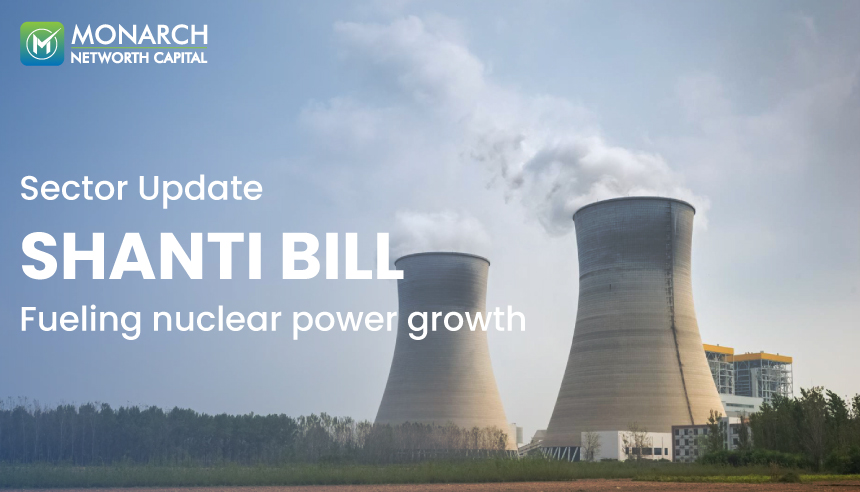
We retain Buy on KSB with Target Price unchanged at Rs 920. The passing of SHANTI Bill (Sustainable Harnessing and Advancement of Nuclear Energy for Transforming India) will act as a strong catalyst for nuclear energy equipment and engineering cos over the medium-to-long term. As private participation gains traction and project visibility improves, ancillary suppliers across nuclear systems, cooling circuits, and critical flow-control equipment will gain immense significance. KSB, with its PTR and a partner to existing NPCIL facilities, will stand to benefit as private players begin investing, supported by the GoI’s continued push for SMRs (small modular reactors) and broader deregulation of the nuclear power sector. We see value unfold over CY26E/27E; factoring in 14%/13% CAGR in revenue/ PAT over CY24-27E.
Under the proposed framework, the Centre may license government entities, private companies, and joint ventures to build, own, operate, and decommission nuclear power plants, including through PPPs, while also permitting participation in select parts of the nuclear value chain such as fuel fabrication (up to certain limits), fuel handling and storage, and the use of approved equipment, technology, and software. Keeping the safety and criticality aspect, functions such as uranium enrichment, spent fuel management, and heavy water production however remain under the control of the Centre. GOI also retains control over radioactive substances, radiation-generating equipment to address safety hazards.
The SHANTI Bill seeks the removal of the supplier liability clause under the Civil Liability for Nuclear Damage Act (CLNDA), 2010, which had earlier deterred foreign participation in domestic nuclear projects. The Bill also caps civil liability for any nuclear incident for operators based on plant size, at up to Rs 30bn for large plants (>3,600 MW), up to Rs 15bn for mid-sized plants (1,500–3,600 MW), and up to Rs 1bn for smaller installations including SMRs. The bill also allows up to 49% FDI in nuclear power projects and aims to establish a unified legal framework for atomic energy. To further deregulate the sector the government has also proposed bringing in a specialized tribunal to address nuclear liability disputes outside the civil courts.
GOI’s ambitious goal of 100 GW capacity by 2047e will entail private sector participation, which is restricted under the existing atomic power laws in India. The passage of SHANTI BILL will be a huge positive as it addresses the long-standing bottlenecks across the nuclear energy value chain, citing rising domestic power demand, the rapid expansion of data centers, and India’s 2070 net-zero commitment as key drivers behind the renewed push for nuclear energy.
Our interaction with experts suggests that pumps and valves account for ~3% of the project cost. KSB Ltd, with its long-standing track record of supplying to NPCIL, stands to benefit as nuclear power generation gains pace. Retain BUY with TP at Rs920. (valued at 45x Sept’27e EPS). Key risks: Unfavorable domestic capex cycle, and further delay in NPCIL approvals.

Click to download the full report on SHANTI BILL - Sector Update
The SHANTI Bill (Sustainable Harnessing and Advancement of Nuclear Energy for Transforming India) aims to reform India’s nuclear power framework by enabling private participation, easing liability norms, and improving project visibility.
The Bill allows private companies, government entities, and joint ventures to build, own, operate, and decommission nuclear power plants, including through PPP models.
Critical functions such as uranium enrichment, spent fuel management, heavy water production, and control over radioactive substances remain under the control of the central government.
The Bill proposes removal of supplier liability under the CLNDA, 2010, and caps operator liability based on plant size, ranging from Rs 1bn for smaller units to Rs 30bn for large plants.
Yes, the Bill allows up to 49% FDI in nuclear power projects and seeks to establish a unified legal framework for atomic energy.
India’s target of achieving 100 GW nuclear capacity by 2047 requires private sector participation, given rising power demand, data center expansion, and net-zero commitments.
KSB has a long-standing track record as a supplier to NPCIL and is positioned to benefit as demand rises for nuclear systems, cooling circuits, and flow-control equipment.
Pumps and valves account for approximately 3% of total nuclear power project costs, according to expert interactions referenced in the update.
KSB is rated BUY with an unchanged target price of Rs 920, factoring in expected revenue and PAT CAGR of 14% and 13% respectively over CY24–27E.
Key risks include an unfavorable domestic capex cycle and further delays in approvals from NPCIL.
Disclaimer: - You are advised to read our disclaimer here: https://www.mnclgroup.com/disclaimers



Empower your finances with ReSach – the stock trading apptrusted by serious investors. Whether you're planning to invest in stocks, explore commodity trading, or need a financial advisor to guide you, Resach brings it all under one platform.
Start trading today with ReSach and unlock seamless investing on the go.
Name of the Company has changed from Networth Stock Broking Limited to Monarch Networth Capital Limited upon Certification of Incorporation received from Registrar of Companies, Mumbai vide certificate dated 13th October, 2015.
If you are not satisfied with the resolution provided, you can lodge your complaint online at: https://scores.sebi.gov.in/link
In case of grievance client can log on to the SMART ODR Portal, if they are unsatisfied with the response provided by us. Your attention is drawn to the SEBI circular no. SEBI/HO/OIAE/OIAE_IAD-1/P/CIR/2023/131 dated July 31, 2023, on “Online Resolution of Disputes in the Indian Securities Market”.
Purchase of REs only gives buyer the right to participate in the ongoing Rights Issue of the concerned company by making an application with requisite application money or renounce the REs before the issue closes. REs which are neither subscribed by making an application with requisite application money nor renounced, on or before the Issue closing date shall lapse and shall be extinguished after the Issue closing date. Please check your dp account for further details.
Please do not share your online trading password with anyone as this could weaken the security of your account and lead to unauthorized trades or losses.
Monarch Networth Capital Limited (‘MNCL’) | CIN No.: L64990GJ1993PLC120014
Unit No. 803-804A, 8th Floor, X-Change Plaza, Block No. 53, Zone 5, Road-5E, Gift City, Gandhinagar - 382050, Gujarat
Ahmedabad
“Monarch House”, Opp Prahladbhai Patel garden, Near Ishwar Bhuvan, Commerce Six Roads, Navrangpura, Ahmedabad - 380009
Mumbai
Monarch Networth Capital Limited, G Block, Laxmi Tower, B Wing, 4th Floor, Bandra Kurla Complex, Bandra East, Mumbai - 400051.
Email for Grievance: grievances@mnclgroup.com
Investors are requested to note that Stock broker (Monarch Networth Capital Ltd) is permitted to receive money from investors through designated bank accounts only named as Up streaming Client Nodal Bank Account (USCNBA). Stock broker (Monarch Networth Capital Ltd) is also required to disclose these USCNB accounts to Stock Exchange. Hence, you are requested to use following USCNB accounts only (Click to View) for the purpose of dealings in your trading account with us. The details of these USCNB accounts are also displayed by Stock Exchanges on their website under “Know/ Locate your Stock Broker".
Mechanism for addressing grievances and information about SCORES.
Monarch Networth Capital IFSC Private Limited (Wholly owned subsidiary of Monarch Networth Capital Limited) is a Registered Fund Management Entity (Retail) having Registration No: IFSCA/FME/III/2025-26/169. Monarch India Growth Fund will be an open-ended Restricted Scheme (Non-Retail) construed as a Category III AIF under the IFSCA (Fund Management) Regulations, 2025. Monarch AIF is a Category III AIF having SEBI Registration No. IN/AIF3/20-21/0787. This material is for informational purposes only and is not intended as an offer or solicitation or investment advice to buy or sell securities. Investments are subject to market risks. The offering is made only through official scheme documents to eligible investors under GIFT IFSC regulations. Investors should read all documents carefully and consult their advisors before investing.
Mechanism for addressing grievances and information about SCORES.
Monarch Networth Capital Limited (‘MNCL’) | CIN No.: L64990GJ1993PLC120014
(As per LODR Regulations and Companies Act, 2013)
Contact information of the designated officials of the listed entity who are responsible for assisting and handling investor grievances : Mr. Nitesh Tanwar
Monarch Networth Capital Limited
Unit No. 803-804A, 8th Floor, X-Change Plaza, Block No. 53, Zone 5, Road-5E, Gift City, Gandhinagar - 382050, Gujarat
Ahmedabad
“Monarch House”, Opp Prahladbhai Patel garden, Near Ishwar Bhuvan, Commerce Six Roads, Navrangpura, Ahmedabad – 380009
Mumbai
Monarch Networth Capital Limited, G Block, Laxmi Tower, B Wing, 4th Floor, Bandra Kurla Complex, Bandra East, Mumbai - 400051.
Phone: 022 - 66476400 / 66476405
Email: cs@mnclgroup.com
Email for Grievance: cs@mnclgroup.com
Listing of Equity Shares on Stock Exchange at
BSE
NSE
(Formerly known as Link Intime India Private Limited)
For any queries related to broking please contact helpdesk@mnclgroup.com.
‘Investments in securities market are subject to market risks, read all the related documents carefully before investing.’